

Our November 2026 Kansas and Missouri education policy update covers proposed school funding reforms in Kansas, Missouri’s delayed funding formula recommendations amid growing budget concerns, new Kansas instructional technology policies, and changes to State Board governance.
This originally appeared in Aligned’s monthly newsletter. Want future updates in your inbox? Sign up today.
Kansas school funding task force returns, weighs various reform options
On November 17-18, the Kansas Education Funding Task Force met to review school finance models prepared by the Kansas Legislative Research Department (KLRD).
The various models were made at the request of Task Force members, ranging from minor to wholesale changes. Each model showed how a policy change would affect state K-12 spending, local property taxes, and individual school districts’ budgets. KLRD used FY 2026 funding data as their baseline, meaning changes were modeled onto the current fiscal year.
Ultimately, these models were not formal recommendations; instead, they were presented as scenarios to help the Task Force understand the tradeoffs of different policy decisions.
How should Kansas allocate funding based on student needs?
One prominent policy several of the models changed was the current at-risk formula, which uses free-lunch eligibility to identify students from low-income backgrounds needing additional support.
In sum, the Task Force examined the following changes:
- Using direct certification instead of the broader free-lunch eligibility to determine at-risk funding.
- Creating a new K-3 proficiency weight to support early literacy.
- Replacing the at-risk weight with the new K-3 proficiency weight to support early literacy based on students’ performance level.
For instance, one model combined a new K-3 weighting with a reduction in the at-risk weighting from 0.484 to 0.4. The analysis showed that redirecting dollars toward early literacy could result in less funding for districts serving larger populations of students from low-income backgrounds.
Although members agreed on the importance of early literacy, they differed on whether resources should be redirected from the existing at-risk program or supported with other funding.
Special education again featured in the committee discussions, which focused on the various model proposals:
- Providing funding on a per-student basis either using disability categories or service hours; or
- Keeping the reimbursement system and changing how much funding the state provides.
Throughout the meeting, members debated the incentives of each proposal — particularly if a policy would incentivize student identification — and how the new approaches would account for the substantial amount of local funding already supporting special education.
Other topics included:
- State funding for pre-K students. A few models expanded eligibility beyond at-risk students to include all preschool students. This led to discussion based on cost, access, and if school finance should support early childhood education.
- Counting students. Members looked at using a 3-year enrollment average.
- Virtual education. One proposal brought virtual students, who are currently funded outside of the formula, into the formula to ensure their funding was adjusted for inflation like other students.
Financial tradeoffs
Overall, the models show how various formula changes can produce very different financial outcomes for the state and school districts.
| Model | Estimated Additional State Aid | Policy Change |
|---|---|---|
| Deer Mouse | $508.1 million | Expand special education funding, revise local funding calculations, and other formula changes |
| Great Horned Owl | $573.3 million | Increase state equalization aid and reduce reliance on local property taxes |
Source: Kansas Legislative Research Department, Education Funding Task Force modeling, November 17–18, 2026. Figures represent hypothetical scenarios, not adopted recommendations.
The Great Horned Owl model is a useful example. It would reduce local property taxes by $498 million because of the increased state aid, which would make up the difference. This shows that increases in state aid do not mean schools receive more funding; the interplay between state and local dollars is crucial.
Members pressure tested assumptions going into the models, such as what resources are available to districts, whether to redistribute existing funding, or shift costs between state and local taxes.
Moreover, the Task Force spent time talking about tax burden, district funding losses, and whether hold harmless protections would be necessary.
By the end of day two, the Task Force requested KLRD to refine their models by the time they meet next in early December.
The November meetings gave us a clearer picture of the options lawmakers are considering. However, substantial questions remain about how costs will be distributed, what the state can realistically afford, and what will help improve student outcomes.
Missouri News
Missouri school funding reform delayed by growing budget concerns
In the final Missouri School Funding Modernization Task Force meeting of the year, Chairman and Senator Rusty Black announced the Task Force’s recommendations would not be made in December.
Instead, in agreement with Governor Mike Kehoe, the Task Force now plans to issue its recommendations sometime in July 2027. This changes the original plan to release recommendations ahead of the legislative session per the Executive Order.
Our takeaway from the last meeting in September was that the state’s fiscal picture was becoming more prominent in Task Force discussions. Most of November’s meeting was a fiscal outlook presentation led by Adam Koenigsfeld, director of Senate Appropriations Staff. Task Force meetings would not continue during the 2027 legislative session, with plans to reconvene afterward
The presentation focused on growing concerns about Missouri’s fiscal outlook. State spending continues to outpace annual revenue collections, and rising Medicaid costs threaten to place additional pressure on the budget.
- FY 2027 operating budget. Missouri appropriated approximately $48.7 billion, including $15.46 billion in state general revenue funding. The remainder comes from federal and other dedicated funds. However, the state expects to collect considerably less general revenue than it has budgeted to spend.
- FY 2027 revenue estimates. The state originally projected $13.65 billion in general revenue collections, requiring 4.6% growth over actual FY 2026 collections. With revenue growth falling short of that pace so far, Koenigsfeld indicated that the estimate would likely be revised downward.
- Declining general revenue balances. Missouri has relied partly on accumulated balances to support spending above annual collections, but those funds have declined from approximately $5.8 billion in FY 2023 to $2.8 billion in FY 2026.
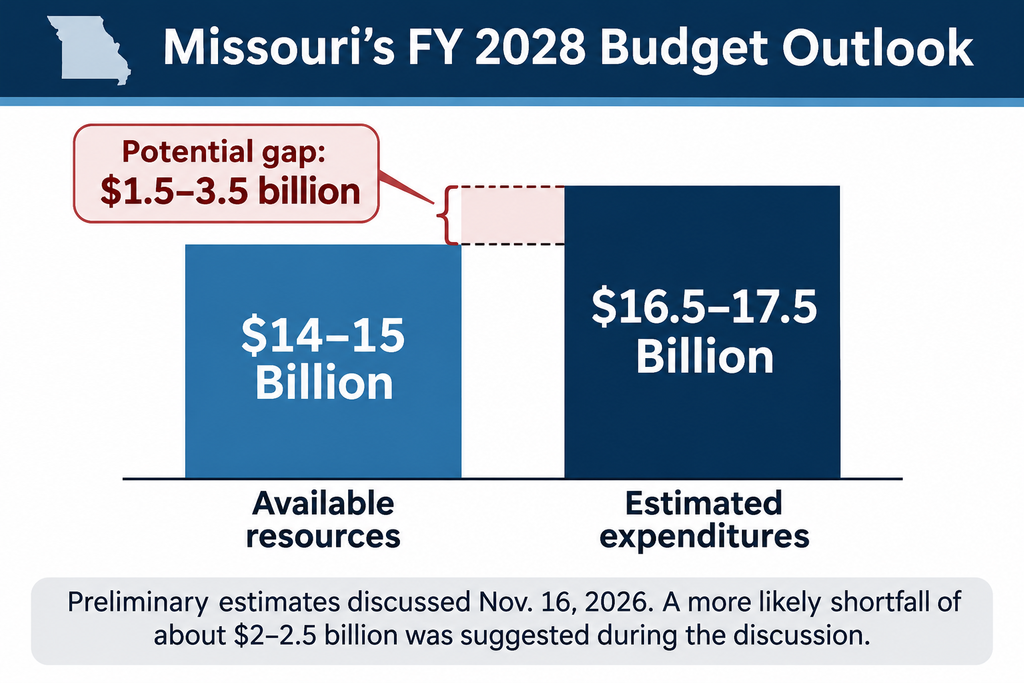
- FY 2028 outlook. Preliminary projections suggest Missouri could have $14–15 billion in available resources against $16.5–17.5 billion in expenditures, creating a potential budget gap of $1.5–3.5 billion. During the discussion, a more likely shortfall of approximately $2–2.5 billion was suggested.
All told, these pressures raise questions about the state’s ability to maintain existing funding commitments, let alone provide additional resources for a new funding formula.
As we mentioned last month, the Missouri State Board of Education approved most of the Missouri Department of Elementary and Secondary Education’s (DESE) FY 2028 budget request but held funding essentially flat for K-12 education. [ES1]
Missouri State Board of Education and Task Force member Kerry Casey explained the State Board decision to not request full formula funding as one made in anticipation of these budgetary issues.
Reform now or wait?
Ultimately, Sen. Black viewed the growing budget uncertainty coupled with potential property tax changes as reasons to postpone advancing recommendations at this time.
However, others on the Task Force argued that fairness in how existing resources are distributed matter — even without additional state funding.
Task Force member Dr. Michael Podgursky spelled out this position plainly: he would rather the state underfund a more rational and equitable formula instead of the current formula.
While members were not debating over the extended deadline, they were expressing different views on how formula design and the state’s fiscal capacity should interact.
Remember, the Task Force has spent months identifying pitfalls of the current formula and debating potential changes:
- Updating the state’s approach to district wealth and local funding capacity.
- Adjusting funding based on student needs.
- Estimating the impacts for districts protected by hold harmless provisions.
These are all big policy issues worthy of conversation. But for the time being, policymakers are increasingly concerned with fiscal policy, moving K-12 funding reform to the backburner.
The Task Force will resume its work following the 2027 legislative session, at which point we will have a better idea of the medium-term budgetary outlook.
Coming soon: Missouri’s higher education funding proposal
Although Missouri’s K-12 funding modernization effort has been delayed, another proposal is expected soon.
The Missouri Department of Higher Education and Workforce Development (MDHEWD) faces a December 1 deadline to submit a new formula to distribute existing state funding among public colleges and universities.
At a late October meeting, department staff outlined a preliminary model that would preserve 90% of each institution’s existing core funding and reallocate the remaining 10% based on earned credit hours (adjusted for program cost and course level).
You can learn more about the proposed model and its potential impact on individual institutions in MDHEWD’s presentation.
We’ll revisit the issue once the department submits its report in December.

Kansas News
Kansas State Board requires districts develop classroom technology policies
During its November meeting, the Kansas State Board of Education voted 6-4 to approve a new instructional technology policy. The policy creates statewide expectations for how schools use technology and maintains local authority over final decision making.
Overall, the policy emphasizes that technology should enhance instruction, facilitate genuine connection between students and teachers, and demonstrate value. Kansas Education Commissioner Dr. Jake Steel made the state’s intentions clear in his statement:
“The State Board has sent a clear message that technology only belongs in the classroom when it strengthens teaching and learning[…] This policy establishes expectations for every Kansas school while recognizing that decisions about how to meet those expectations are best made by the people closest to students.”
Digging into the details, the policy requires all public and accredited nonpublic schools to develop a local instructional technology policy and implementation plan addressing the following:
- Student technology use. Outline expectations for school-issued devices, including classroom use, differentiation by grade level, and whether devices can be taken home.
- Artificial intelligence. Consider what forms of AI are permitted, limited, or prohibited for students and educators.
- Digital citizenship and student wellbeing. Define the approach to online safety, responsible technology use, and students’ holistic wellbeing.
- Privacy and accountability. Include student data protections and cybersecurity.
The policy encourages districts to use evidence-base instructional technology and recommends nondigital approaches when technology does not provide educational value.
Districts will solicit feedback from families and community stakeholders to eventually submit their implementation plans to the Kansas Department of Education (KSDE) by July 1, 2027.
In addition, schools must garner parental acknowledgement of their technology use plans before providing students access to devices.
Instead of a statewide restriction, the State Board is establishing common expectations and allowing local school boards to determine tech use in their schools. The policy is scheduled to expire in 2030, unless the State Board renews or amends it.
Looking ahead: in the December meeting, the State Board will vote on its own legislative priorities ahead of the 2027 session.
State Board considers new changes to its own policies
The State Board also discussed proposed changes to policies governing Board member conduct, requests for information from KSDE staff, and elections for Board leadership. (See all these proposals beginning on pg. 252 of the Board materials.)
Board code of conduct. This policy would establish expectations for “professional misconduct,” including civility, confidentiality, conflicts of interest, and respect for Board decisions.
One aspect that has come under scrutiny is how “allowing outside group allegiances to improperly influence judgement” would be defined and determined to violate the code.
Requests for information. The proposed policy would require written requests for KSDE staff reports, research, or analysis. Requests estimated to take more than two hours to fulfill would require discussion and/or approval by the Board if not revised or withdrawn.
During the meeting, State Board member Jim Porter raised concerns:
“I like having a form. I like that requests are formal […] My concern is that it would ever be like subject to somebody’s approval. I might be digging into information, and the board of the whole doesn’t have to agree with the information I’m interested in as an elected member. I have the right to access information that I find relevant to my job, even if nine other people on this board could not care less about what I’m interested in.”
Election of State Board Officers. This policy would require candidates for chair and vice chair to submit their names before the last Friday in December, before the Board conducts its biennial January leadership election in odd years.
This raises an immediate question: what about new members? This requirement occurs before new members are sworn in, meaning new members could not be officer candidates upon assuming office in their first year.
Finally, the Board will consider a new draft policy outlining a request for proposal process for the Board to hire an attorney to represent members during litigation.
The big picture: these proposals come as the State Board prepares for new members following November’s elections. The Board will vote on these policies in their next meeting.
Stay informed on Kansas and Missouri education policy
Want to stay up to date on the latest education policy developments in Kansas and Missouri? Subscribe to Aligned’s monthly newsletter for timely updates, policy analysis, and insights on the issues shaping education and workforce development in both states.