

Our June 2026 Kansas and Missouri education policy update examines teacher incentive pay, Missouri school funding reform and leadership changes, and Kansas school finance and accountability. This originally appeared in Aligned’s monthly newsletter. Want future updates in your inbox? Sign up today.
What a new Texas study teaches us about teacher compensation
We are back and excited to bring you evidence from one of the more ambitious teacher compensation strategies in the country, with early research suggesting that it may be paying off for Texas.
A new policy brief from Texas Tech University’s Jacob Kriksey looked at the impact of Texas’s Teacher Incentive Allotment (TIA), a statewide policy created in 2019 to support school districts ability to retain effective teachers and improve instruction in hard-to-staff schools.
- Under the policy, teachers can earn additional compensation above their base salary.
- More than 800 Texas districts receive TIA funds.
- Texas provided $480 million in TIA funding in 2024-25, bringing total funding over $1 billion since 2019.
The policy requires that districts create local evaluation plans using multiple measures of teacher effectiveness, like classroom observation, student growth and other performance indicators (TEC §48.112; §21.3521).
Teachers who meet state standards earn a designation: Acknowledged, Recognized, Exemplary, or Master. Each designation generates additional funding for the district each year a teacher keeps their designation. In turn, districts are required to offer a substantial share of those funds as compensation.
Funding is higher for teachers with designation working in rural schools and schools serving higher concentrations of students from low-income backgrounds, creating a stronger incentive for effective teachers to work in schools that face the greatest staffing challenges.
The policy brief offered some notable findings for the program. After districts adopted the program, student achievement increased ~0.09 to .10 standard deviations in math and reading (the brief estimates that to mean roughly one-third of a year of learning gained).
Teacher turnover also declined for districts receiving TIA funds, and the effects grew over time. By the third and fourth years of implementation, the program was correlated with lower attrition among the most effective teachers. Other analysis by the state also found that the TIA teachers were more likely to stay in classrooms.
Previous research on merit and performance-based compensation suggests that design matters a great deal for effectiveness.
- Studies have found that incentives can influence teacher behavior when the financial rewards are meaningful, when educators clearly understand the system, and when compensation is tied to credible measures of performance.
- However, programs with small bonuses, unclear expectations or weak links between compensation and individual effectiveness have often produced limited results.
Texas’s TIA example is worth considering because it combines features that prior research suggests are important: meaningful compensation, multiple measures of teacher effectiveness, and targeted support for high-need schools with recurring funding over time.

Missouri News
More state education leadership changes for Missouri
On the heels of Dr. Karla Eslinger retiring from her role as Missouri Commissioner of Education on June 1, another departure occurred this week.
On Tuesday, Missouri State Board of Education President Mary Schrag resigned from her position on the board.
In the press release, Schrag discussed her reason for leaving:
“With new State Board members well established and more on the way, this is a natural and logical time for me to step away […] It’s been an honor to serve Missouri students alongside all the State Board members.”
Schrag was originally appointed to the board by former Governor Mike Parson in 2019. She was elected Board President last year by her board colleagues, chaired the Legislative Priorities Committee, and championed legislation increasing teacher pay in 2024.
Missouri State Board Vice President Brooks Miller is set to assume the President role until the Board holds its own elections later this month.
In the wake of this news, Governor Mike Kehoe announced two appointments to the State Board:
- Jordan Bradberry (Kansas City), a health tech product manager turned real estate developer.
- Robbie Myers (Popular Bluff), who serves as an emergency management director for Butler County and previously worked at Three Rivers Community College as vice president of administration and government affairs.
At the time of this newsletter’s release, no interim Commissioner has been announced to replace Dr. Eslinger.
Property tax challenges continue for Missouri school funding task force
Back for their first meeting since late March, the Missouri School Funding Modernization Task Force reconvened to analyze a familiar topic: how local property taxes intersect with the state’s K-12 funding formula.
Members grappled with how local property taxes — or how much funding effort school districts contribute to funding education — are inaccurately assessed across Missouri.
To determine state funding, any formula will look to offset state funding with local funding capacity. The more local property taxes a district can raise, the less state funding they receive. That means accuracy is crucial to ensure state funding flows more to counties with lower property wealth and not just to those underassessing properties.
However, officials from the Missouri State Tax Commission shared data that revealed 91 counties (79%) were assessing home values below 90% of their market value.
- That means roughly 60% of all Missouri students reside in a county that assesses properties significantly below market value.
- For reference, only 25% of counties underassessed properties below 90% of market value in 2017-2018.
State Tax Commission officials cited county-level staffing issues, limited sales reporting outside of the major counties in a timely fashion, and statutory limits on assessment increases as structural drivers to underassessment.
Whatever the cause, the effect is clear: counties have not kept pace with rising property values in the wake of the rapid increase of 2021-2023.
Task force members teased out the implications of widespread assessment inaccuracy. Some asked if a new formula could create unintended funding inequities between districts. Others pointed out that correcting assessment disparities could unintentionally reduce funding for high-poverty communities.
Kari Monsees, a former Deputy Commissioner of Education and current task force facilitator, presented options to address the assessment issue:
- A plan to gradually adjust property values used in the formula over a 10-year period based on State Tax Commission data.
- Recommend tax policy changes separately from the funding formula.
- Reduce reliance on property wealth as an indicator for local funding effort and incorporate other measures of fiscal capacity.
The task force spent considerable time on the last proposal, looking at a Combined Wealth Index that would blend property tax capacity with area household income to measure local funding effort.
While no consensus emerged, early analysis (pg. 20) suggests that greater reliance on income measures could increase the number of districts requiring hold harmless protections, policies that prevent districts from experiencing funding reductions during a transition to a new formula or over time.
Ultimately, they highlighted that measuring local funding effort may become one of the most impactful decisions facing the task force. While everyone appears to agree that property values should reflect current assessments, significant questions remain about balancing school finance equity between state and local school district funding.
Kansas News
Education Funding Task Force explores student outcomes, accountability
The Kansas Education Funding Task Force spent much of its two-day May meetings examining how Kansas should define and measure student success.
Task force members heard presentations from national experts and state legislative staff highlighting student-level data and other state approaches to accountability.
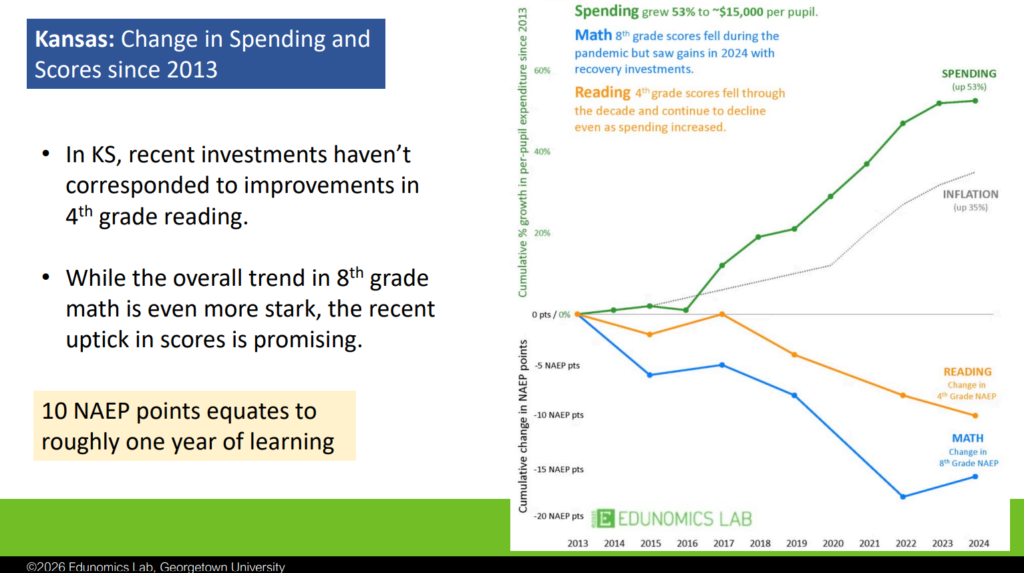
One newsworthy presentation came from Dr. Margurite Roza of Georgetown University’s Edunomics Lab, who challenged members to think critically about the relationship between spending and outcomes for students.
- She noted that Kansas has significantly increased spending over the past decade while student achievement trends remain mixed.
- Dr. Roza also pointed out enrollment declines coupled with staffing growth as factors policymakers should consider when evaluating funding decisions.
Members also heard from Education Commission of the States Senior Policy Analyst Lauren Bloomquist, who gave an overview of school quality and success measures that states incorporate into accountability systems. Across the states reviewed, accountability systems generally combined:
- Measures of academic achievement
- Student growth
- Graduation rates
- College and career readiness
- School quality indicators, with several states using public report cards or A-F school grading systems to communicate results.
Kansas Legislative Research Department staff likewise highlighted state accountability systems, including A-F letter grades for school districts. The discussion focused primarily on accountability frameworks in Arizona, Arkansas, Louisiana, Maine, Maryland, and Mississippi, several of which have attracted national attention for their improvements in student achievement.
Teacher incentive programs like merit pay and outcomes-based funding models were also a topic of discussion.
While the task force has not put a funding proposal on the table yet, the discussion highlights an important question facing their work: how can the state create stronger connections between funding and accountability to improve student outcomes?
That question becomes more important as the task force moves closer to providing recommendations to the wider legislature for the state’s next school finance system.
To date, much of the task force’s work has focused on specific aspects of the formula’s mechanics; how Kansas funds special education, at-risk students, adjusts for inflation, etc. This meeting clarified that members were thinking more broadly about what outcomes those investments should produce, in addition to how the state should measure progress towards them.
The road ahead: the Taskforce’s timeline has yet to be determined. During their May meeting, the Legislative Coordinating Council (LCC) approved only two additional task force meetings, despite requests from task force leadership for 10 additional meetings through the end of 2026.
The LCC indicated it would revisit this issue later this month and asked the task force to provide a clear roadmap for completing its work, hinting they would reconsider the number of meetings.
KSDE reorganizes key accountability and school improvement functions
The Kansas State Board of Education approved a new Division of Accountability and Technology within the Kansas State Department of Education (KSDE). Overall, the move is intended to create a more complimentary approach to school improvement and tracking student achievement.
The new Division will be led by Dr. Zach Conrad, who was appointed as a new deputy commissioner of education last month. Dr. Conrad will oversee state and federal accountability systems for KSDE, in addition to assessment and research efforts, education data reporting, and new technology infrastructure that supports schools and stakeholders across Kansas.
According to the KSDE press release, this restructuring effort is designed to separate the state’s role in measuring student performance and the work of supporting districts.
Although accountability and school improvement are traditionally intertwined areas of education policy, agency leaders said that districts could be better supported when evaluation and improvement efforts are distinct.
- KSDE will create a new implementation and supports team focused on school improvement.
- Meanwhile, accountability, assessment, research, and technology teams and roles will move under the new Division.
- The press release also indicated more organizational changes to come following these changes.
All these changes come as Kansas reckons with student achievement, considers changes to accreditation, and keeps continuous improvement in focus. The goal seems clear: improve communication, make expectations clearer, and better target support schools in need.
Aligned’s take: Accountability systems, assessments, data reporting, and school improvement are crucial for KSDE’s functions — not to mention how we all understand what’s going on and respond to challenges. With new leadership and structure in place, it will be worth watching these and other upcoming changes in the years ahead.
This originally appeared in Aligned’s monthly newsletter. Want future updates in your inbox? Sign up today.