
Our July 2026 Kansas and Missouri education policy update examines Missouri school funding reform and A–F grades, a Kansas audit of industrial revenue bonds, and upcoming Aligned events and news. This originally appeared in Aligned’s monthly newsletter. Want future updates in your inbox? Sign up today.
Missouri School Funding Task Force confronts tradeoffs
The Missouri School Funding Modernization Task Force’s July meeting marked a shift in both tone and substance. Instead of continuing to diagnose problems with the current formula, members spent more time debating the consequences of replacing it.
Until now, many policy choices have been considered individually. But even modest changes could have a significant cumulative effect on how state aid is distributed among districts.
The Task Force has now narrowed its focus to two potential formula models and is examining the cost, distributional effects and political viability of each.
- Model A would modernize Missouri’s current formula while keeping its basic structure. It would update the adequacy target, student count, regional cost adjustment and local-effort calculation, while adding new student weights. Model A would continue calculating the total dollar amount each district is expected to raise locally and subtracting it from the district’s total funding need.
- Model B would use a different method to divide state and local responsibility. It would combine district property wealth and area household income to determine the percentage of the adequacy target the state should fund, in addition to new student weights.
In simple terms, Model A calculates how many dollars a district is expected to raise locally, while Model B calculates the percentage of the adequacy target the district is expected to cover.
The Task Force has not selected a preferred model and may ultimately recommend both.
The meeting’s central theme was clear: modernizing the formula will create financial winners and losers.
That tension surfaced during a lengthy discussion of property assessments. Missouri counties assess property at different percentages of market value, meaning assessed values do not always provide a consistent measure of local fiscal capacity. Districts in underassessing counties can appear less wealthy than they are, potentially increasing the state aid calculated on their behalf.
Members disagreed over whether the school funding formula should correct those distortions.
- Some argued that a rational formula should not knowingly rely on inaccurate property values.
- Others warned that districts should not be financially penalized for county assessment practices they do not control.
The same conflict emerged during the discussion of hold harmless funding. Updating the formula could increase the number of districts that would otherwise lose state aid, raising both the cost and political importance of transition protections.
Some members argued that permanent protections may be necessary to pass a new formula. Others favored temporary protections that phase out over time.
Several emphasized that the Task Force should first design a rational, equitable and sustainable formula, then determine how to manage the transition.
Throughout the meeting, members repeatedly referenced district-level simulations as an important tool for understanding these tradeoffs. Aligned has been involved in supporting that modeling work, and we may have more to share in the months ahead.
Interested in learning more? Read our full analysis of the meeting for a closer look at the two models, the property tax assessment debate, and the future of hold harmless funding.
Kansas news
Industrial revenue bonds under the microscope
A new state audit takes a closer look at industrial revenue bonds (IRBs), a debt financing tool that local governments across Kansas have increasingly used to attract business investment.
Overall, the audit report raises a hard question for state and local policymakers: does Kansas have sufficient oversight over this program?
In Kansas, local governments issue IRBs to help finance business projects such as new facilities, expansions, renovations or equipment purchases. Under IRB deals, the local government temporarily owns the financed property and leases it back to the business, which makes the payments used to repay the bonds. Crucially, taxpayer dollars are not used to pay off the debt.
In general, IRB projects may qualify for two major tax benefits:
- A property tax exemption on the financed property for up to 10 years; and
- A sales tax exemption on eligible project costs, like construction materials, equipment, and certain services.
Following up on a previous 2022 audit of IRBs, Kansas legislative auditors sought to examine how accurately local governments report on IRBs and what the general fiscal effect was on the state.
While the audit found substantial fiscal effects of IRBs statewide over 14 years (2010-2014), the total cost remains unclear due to significant data limitations.
According to the report, Kansas local government issued about 955 IRBs worth ~$18.3 billion. Of that amount, auditors estimated that IRB property tax exemptions maybe have reduced local revenues by as much as $1.1 billion.
Of that total, roughly:
- $436 million, or 40%, would have gone to school districts
- $316 million to counties
- $182 million to cities
- $151 million to other local taxing entities
- $13 million to the State
However, auditors were quick to point out that this figure represents the maximum potential forgone revenue; they did not conclude that $1.1 billion would have been collected absent exemptions, since some projects may not have happened without the incentive.
The auditors encountered one huge challenge: they could not estimate the value of sales tax exemptions tied to IRB projects. Kansas currently does not track those exemptions in a way that isolates the IRB program’s fiscal effect from other sales tax exemptions.
In addition, although local governments must prepare cost-benefit analysis before granting tax exemptions to IRB projects, auditor reviews showed many inaccuracies in those estimates.
Auditors reviewed 23 projects and found local estimates of forgone property tax revenue ranging from 94% below actual amounts to more than 6000% above (yes, that is the real number).
Though the sample was limited, the auditors said these findings indicated there were broader issues. The audit report specifically mentions issues with officials using incorrect assessment rates, unrealistic property value assumptions, changing project details, and including areas in the analysis that were not included in the intended project’s property.
In reaction, Senator Joe Claeys told the Sunflower State Journal that these cost-benefit analyses were “compliance theater.”
“It really doesn’t seem like it’s providing any value.”
Sedgwick County was explicitly identified in the audit for issuing at least 112 IRB property tax exemptions and 18 other development exemptions that had not been forwarded to the Kansas Board of Tax Appeals (BOTA). The report cited weak internal controls, unclear deadlines, and limited state oversight.
In response, Sedgwick County has said it discovered these issues itself last July, changed its procedures to prevent it in the future, and argues the exemptions were warranted and would’ve been approved.
The audit report recommended the following for state lawmakers to consider:
- Set a statutory deadline for counties to forward exemption applications.
- Create a BOTA process to track expected applications.
- Improve Kansas Department of Revenue data checks.
- Strengthen or reconsider the cost-benefit analysis requirement.
For us in the education community, it’s another reminder that local tax policy plays a big role in affecting the tax base available for school districts.
Register for our upcoming webinar
Join Aligned on Wednesday, August 12, from 11 a.m. to noon for a virtual conversation on the state of child care in Kansas, recent changes to the child care tax credit and how employers can better support working families.
The discussion will feature Amanda Poyser, senior program manager at Child Care Aware of Kansas, and Brent Lewis, executive director of OneCommunity.
Participants will hear about current child care challenges, practical steps employers can take and the need for stronger partnerships across the business, nonprofit, provider and policy sectors.
Child care is not just a family issue. It is a workforce, economic development and community issue.

Missouri news
DESE releases A-F grading framework for schools and districts
The Missouri Department of Elementary and Secondary Education (DESE) unveiled its own A-F School and District Grading Framework, responding to Governor Mike Kehoe’s executive order issued in January.
The framework would create annual letter grades issued for public school districts and charter school, with private schools allowed to participate voluntarily. DESE stressed that new grade cards would supplement Missouri’s existing accountability systems, not replace them entirely.
While the framework remains subject to review and change from the Governor’s office, as well as final approval by the Missouri State Board of Education, its worth examining closely.
The goal of A-F grading is straightforward: give families and communities a simpler way to understand school performance. The design of the grading, however, relies on several measures instead of reducing a school’s grade to a single test score.
DESE would assign separate grades to individual school buildings and to school districts. School-level grades would reflect the students served in each building, while district grades would combine student-level results across all schools in the district.
Public charter schools would also receive grades, including district-level grades when a charter organization operates multiple buildings.
For elementary and middle schools, grades would be based on the following.
- Academic achievement (38%): Student performance in English language arts, mathematics, science and literacy.
- Value-added growth (33%): Student progress compared with peers who started at similar achievement levels.
- Growth toward proficiency (29%): Whether students below proficiency are on track to reach it within three years.
For high schools, grades would be based on:
- Academic achievement (28%)
- Value-added growth (28%)
- Success Ready Graduate measures (22%): Indicators such as college entrance exams, Advanced Placement, industry credentials and postsecondary coursework.
- Four-year graduation rate (22%): The share of students graduating within four years.
DESE will also need to develop two measures not currently used in Missouri’s accountability reporting.
The first would be growth toward proficiency, which would assess whether students who are not yet proficient according to state standards are making progress to reach proficiency within three years.
Unlike the state’s existing value-added model, it would establish an individual trajectory based on the gap between a student’s prior score and the proficiency threshold.
The second is a stand-alone literacy metric. In the framework, DESE proposes using Lexile scores — a common tool to measure student’s reading ability — from state-approved foundational reading assessments in grades 1-2 and the Missouri Assessment Program’s English language arts assessments in grades 3-8.
DESE issued further guidance this week that all districts must use a state-approved foundational reading assessment beginning in 2026-27.
The framework proposes the following scale for both school and district-level grades:
- A = 100% – 89%
- B = 88% – 76%
- C = 75% – 63%
- D = 62% – 50%
- F = 49% – 0%
We’ll learn more soon
Although the proposal remains subject to change, the State Board of Education is scheduled to review it in August and consider approval in September.
DESE expects to produce preliminary grade cards using earlier data, which could become available before the first scheduled public release. The framework currently calls for grade cards using 2025–26 data to be released publicly in April 2027, followed by grade cards using 2026–27 data — the first expected to include every required element — in September 2027.
Going forward, the Department also highlighted some implementation challenges with the framework.
For instance, DESE estimates one-time costs of $518,000 and recurring annual costs of approximately $715,000, with the state not yet identifying sustainable funding. The timeline would also require shorter testing, data-correction and appeals windows, raising concerns about data quality during the initial rollout.
Stay tuned as we learn more about the new A-F framework once it’s finalized.
Staff announcement!
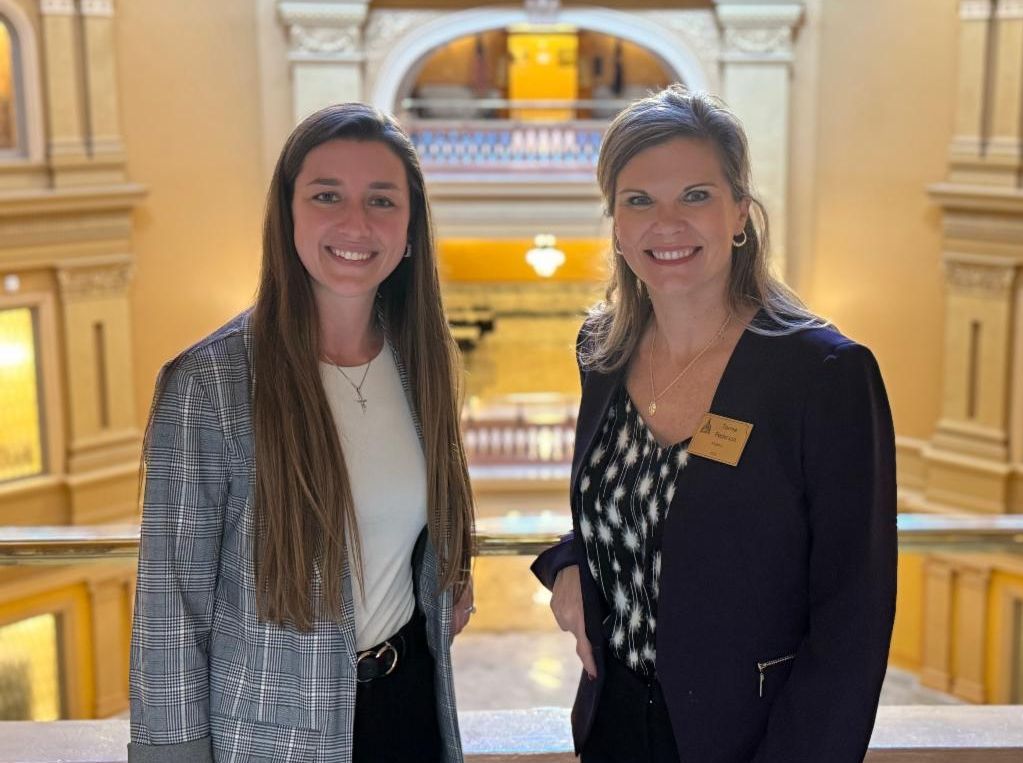
Please join us in congratulating Claudia Fury-Aguirre, MPA on her promotion to Director of Policy & Strategic Partnerships at Aligned!
In her previous role as Manager of Policy & Outreach for Kansas, Claudia played a pivotal role in advancing Aligned’s policy priorities by building strong relationships with legislators, advocates, business leaders, and education stakeholders across Kansas.
She also helped translate complex policy issues into clear, accessible communications and social media content, ensuring more Kansans could engage in meaningful conversations about education and workforce policy. Her leadership has strengthened Aligned’s presence across the state and elevated our voice as a trusted, nonpartisan advocate for policies that prepare every student for success in education, career, and life.
As Director of Policy & Strategic Partnerships, Claudia will lead Aligned’s Kansas legislative strategy by connecting research, partner input, policymaker relationships, and strategic communications into a year-round advocacy effort.
She will also expand and strengthen Aligned’s statewide network of business leaders, educators, workforce partners, policymakers, and community organizations, creating more opportunities for collaboration and shared action around education and workforce priorities. In addition, Claudia will oversee Aligned’s communications, events, and public engagement efforts, ensuring our voice remains consistent, accessible, nonpartisan, and directly aligned with our policy and partnership goals.
Claudia’s passion for improving education outcomes, her collaborative leadership, and her ability to bring diverse stakeholders together make her exceptionally well-suited for this expanded role. We are excited to see the continued impact she will have as Aligned advances policies and partnerships that strengthen education-to-workforce pathways across Kansas.
Congratulations to Claudia on this well-deserved promotion!
Remember to sign up for our monthly newsletter.