
Missouri school funding reform will face a significant delay after the state’s School Funding Modernization Task Force announced plans to postpone its final recommendations until July 2027.
In the final Missouri School Funding Modernization Task Force meeting of the year, Chairman and Senator Rusty Black announced the Task Force’s recommendations would not be made in December.
Instead, in agreement with Governor Mike Kehoe, the Task Force now plans to issue its recommendations sometime in July 2027. This changes the original plan to release recommendations ahead of the legislative session per the Executive Order.
Sen. Black said that Task Force meetings would not continue during the 2027 legislative session, with the plan to reconvene after.
Our takeaway from the last meeting in September was that the state’s fiscal picture was becoming more prominent in Task Force discussions. Most of November’s meeting was a fiscal outlook presentation led by Adam Koenigsfeld, director of Senate Appropriations Staff.
Budget outlook
The presentation focused on growing concerns about Missouri’s fiscal outlook. State spending continues to outpace annual revenue collections and rising Medicaid costs threaten to place additional pressure on the budget.
- FY 2027 operating budget. Missouri appropriated approximately $48.7 billion, including $15.46 billion in state general revenue funding. The remainder comes from federal and other dedicated funds. However, the state expects to collect considerably less general revenue than it has budgeted to spend.
- FY 2027 revenue estimates. The state originally projected $13.65 billion in general revenue collections, requiring 4.6% growth over actual FY 2026 collections. With revenue growth falling short of that pace so far, Koenigsfeld indicated that the estimate would likely be revised downward.
- Declining general revenue balances. Missouri has relied partly on accumulated balances to support spending above annual collections, but those funds have declined from approximately $5.8 billion in FY 2023 to $2.8 billion in FY 2026.
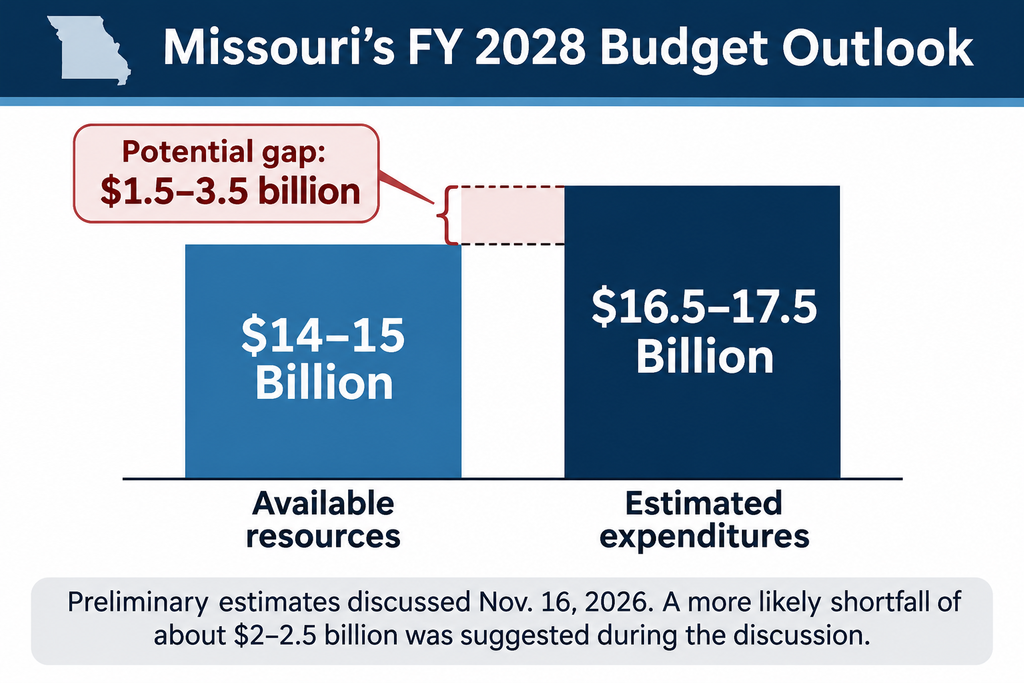
- FY 2028 outlook. Preliminary projections suggest Missouri could have $14–15 billion in available resources against $16.5–17.5 billion in expenditures, creating a potential budget gap of $1.5–3.5 billion. During the discussion, a more likely shortfall of approximately $2–2.5 billion was suggested.
All told, these pressures raise questions about the state’s ability to maintain existing funding commitments, let alone provide additional resources for a new funding formula.
Where Missouri’s General Revenue Goes
FY 2027 Operating Budget: $15.46 Billion
| Spending Category | Share |
|---|---|
| Elementary & Secondary Education | 30.8% |
| Social Services | 21.6% |
| Mental Health | 11.3% |
| Higher Education & Workforce Development | 7.8% |
| Employee Benefits | 7.1% |
| Corrections | 6.2% |
| Health & Senior Services | 4.0% |
| Judiciary, Public Defender & Public Safety | 3.2% |
| All Other Agencies | 2.8% |
| Office of Administration | 2.4% |
| Transportation | 1.6% |
| Economic Development, Labor & Insurance | 0.7% |
| Agriculture, Conservation & Natural Resources | 0.5% |
Source: Missouri School Funding Modernization Task Force, November 16, 2026, slide 12. Percentages may not total exactly 100% due to rounding.
As we mentioned last month, the Missouri Department of Elementary and Secondary Education’s (DESE) FY 2028 budget request would hold funding essentially flat for K-12 education.
Missouri State Board of Education and Task Force member Kerry Casey explained the State Board decision to not request full formula funding as one made in anticipation of these budgetary issues.
Missouri Foundation Formula: FY 2028 Budget Request
| Budget Measure | Amount |
|---|---|
| FY 2027 Appropriation | $4.283 billion |
| Estimated FY 2028 Full Funding Requirement | ~$4.553 billion |
| State Board’s FY 2028 Request | $4.283 billion |
| Difference from Full Funding | ~$270 million |
Source: Fiscal Year 2028 Budget – NDIs and Supplementals , Missouri Department of Elementary and Secondary Education. Figures rounded. Full funding requirement is approximate.
Reform now or wait?
Ultimately, Sen. Black viewed the growing budget uncertainty coupled with potential property tax changes as reasons to postpone advancing recommendations at this time.
However, others on the Task Force argued that fairness in how existing resources are distributed matter — even without additional state funding.
Task Force member Dr. Michael Podgursky spelled out this position plainly: he would rather the state underfund a more rational and equitable formula instead of the current formula.
While members were not debating over the extended deadline, they were expressing different views on how formula design and the state’s fiscal capacity should interact.
Remember, the Task Force has spent months identifying pitfalls of the current formula and debating potential changes:
- Updating the state’s approach to district wealth and local funding capacity.
- Adjusting funding based on student needs.
- Estimating the impacts for districts protected by hold harmless provisions.
These are all big policy issues worthy of conversation. But for the time being, policymakers are increasingly concerned with fiscal policy, moving K-12 funding reform to the backburner.
The Task Force will resume its work following the 2027 legislative session, at which point we will have a better idea of the medium-term budgetary outlook.