

Our August 2026 Kansas and Missouri education policy update examines community college bachelor’s degrees, Kansas’ new assessment pilot, Missouri school finance reform, and upcoming Aligned webinars and news. This originally appeared in Aligned’s monthly newsletter. Want future updates in your inbox? Sign up today.
Do employers value community college bachelor’s degrees?
Over the last 40 years, demand for workers with postsecondary credentials has increased substantially.
A 2023 Georgetown University analysis of U.S. Bureau of Labor Statistics data puts that shift into perspective:
- In 1983, only 11% of jobs required a bachelor’s degree; 36% of jobs required a high school diploma and a further 32% of jobs did not require a high school diploma.
- By 2021, the percent of jobs that required a bachelor’s degree grew to 22%, in addition to the 12% that required an associate’s degree and 14% that required a graduate degree.
Policymakers and higher education officials have traditionally focused on expanding access to four-year institutions. Meanwhile, community colleges enroll millions of students, disproportionately serving working adults, lower-income students, and other populations historically underrepresented in higher ed.
Although many community college students intend to transfer to a four-year institution to obtain a bachelor’s degree, data from the National Student Clearinghouse shows that only 31.6% do so — and only 48.7% of those students go on to complete their degree.
That trend has fueled interest in community college bachelor’s degrees (CCBs), which allow students to earn four-year degrees without transferring institutions.
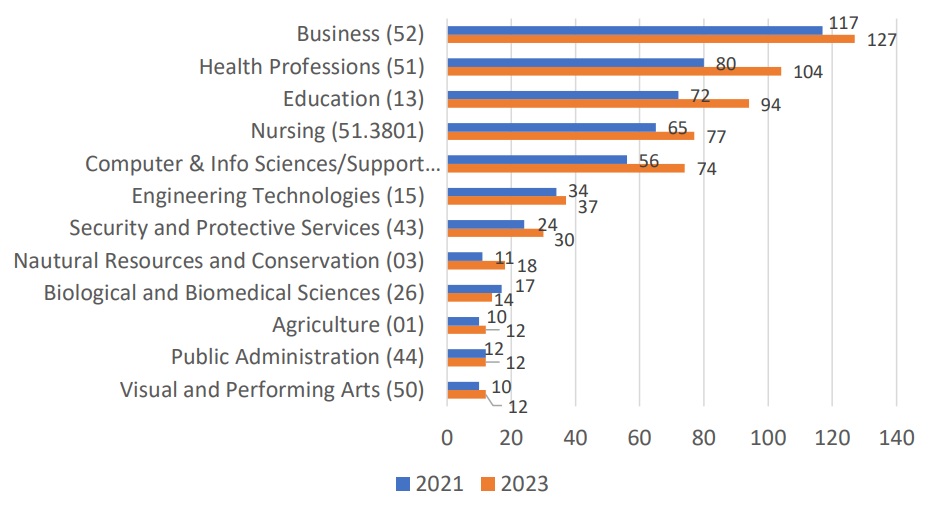
Source: Community College Baccalaureate Association, 2024
According to the Community College Baccalaureate Association, at least 24 states (including Missouri) now allow public two-year institutions to award bachelor’s degrees. About 16% of community colleges nationally offer them, commonly in workforce-oriented fields such as business, healthcare, technology, and education.
At least two Missouri higher ed institutions offer CCBs currently:
- Ozark Technical Community College recently launched a CCB in Science in Respiratory Therapy.
- St. Louis Community College also offers a CCB for Respiratory Care.
Crucially, the case for CCBs depends in part on their labor market value. Lucky for us, a new NBER white paper sheds some light on CCBs, specifically looking at their effect on the early childhood education (ECE) labor market.
The study conducted a pilot résumés audit: researchers submitted 4,698 fake résumés to 1,570 ECE job vacancies in Texas and Washington, randomly varying whether applicants held an associate degree, a community college bachelor’s degree, or a bachelor’s degree from a traditional four-year institution.
The result? Researchers found no statistically significant difference in interview requests across the three credentials. Roughly 22–23% of applicants received an interview request regardless of degree type.
A follow-up survey of 70 participating employers and hiring managers provides some explanation.
- Respondents rated work experience as considerably more important than degree type, field of study, or the institution an applicant attended.
- In fact, the specific college attended received an average importance rating of just 2 out of 10.
The authors issue an important caveat: ECE is an unusually tight, relatively low-wage labor market. Notably, only 8% of jobs in the study’s sample required a bachelor’s degree and researchers could not apply to public school positions because those applications required Social Security numbers.
ECE employers may be more likely to consider applicants with different credentials compared with other sectors. It’s a question the authors will explore in an expanded study across additional fields in the coming months.
The paper also complicates a core argument in favor of CCBs: affordability. Community colleges typically have lower published tuition, but four-year institutions can offer substantially more grant aid to offset that cost. The researchers found that simple sticker-price comparisons can “substantially overstate the affordability advantage of CCB programs,” especially for low- and middle-income students.
Supporters see CCBs as one tool to meet workforce needs, broaden access to bachelor’s degrees, and avoid the pitfalls associated with transferring between institutions. Critics raise concerns about institutional mission creep, competition with four-year universities, and the additional costs and administrative responsibilities placed on community colleges.
For now, the evidence is still developing. However, this pilot provides an important early finding: at least in ECE, employers do not appear to penalize applicants simply because their bachelor’s degree came from a community college. As more states consider authorizing or expanding these programs, the larger follow-up study should tell us whether that finding holds across the broader labor market.

Kansas News
Kansas approved to pilot innovative assessments in six school districts
At the end of July, the Kansas Department of Education (KSDE) announced that the U.S. Department of Education approved a five-year pilot for a new statewide assessment and accountability system.
Pilot districts include:
- Kansas City, Kansas USD 500
- Olathe USD 233
- Geary County USD 475
- Dodge City USD 443
- Great Bend USD 428
- Humboldt USD 258
KSDE plans to add more districts over the five-year pilot as the state learns more about the assessment’s “technical quality, comparability, accessibility and effectiveness.”
Traditionally, state accountability relies on annual assessments given at the end of the year — referred to as summative assessments. KSDE argues that one problem with this model is that the information arrives too late to help educators adjust instruction for students during the school year.
The new Kansas Through-Year Curriculum-Directed Assessment is designed to address that challenge by providing rigorous quarterly assessments aligned with the content students are learning throughout the year and with Kansas Academic Standards.
KSDE states that results from these assessments will be available 72 hours after each testing window closes.
In the press release, new Commissioner of Education Dr. Jake Steel explained the new approach:
“Our goal is to ensure Kansas has the right assessment system, one that gives educators the right information at the right time to strengthen instruction and better meet the needs of every student […] We believe the Kansas Through-Year Curriculum-Directed Assessment can do just that by providing timely, meaningful data educators can use to guide high-quality instruction.”
During the first year, Kansas City, Kansas and Olathe use the new assessments in lieu of the current Kansas Assessment Program (KAP) summative assessments. The remaining four districts will use both systems, offering comparative evidence through the 2026-27 school year.
KSDE has big plans for this pilot
During the August Kansas State Board of Education meeting, Deputy Commissioner Zach Conrad gave more information and answered Board members’ questions.
One noteworthy piece of news Dr. Conrad shared was the proposed scope of this new assessment system.
- Year 1 (SY 2026-27): 6 districts using the new assessment system
- Year 2: 16 districts
- Year 3: 35 districts
- Year 4: 80 districts
- Year 5 (SY 30-31): 284 districts — all Kansas school districts
At the end of year five, the U.S. Department of Education will ask KSDE to review the effectiveness of the pilot and whether the state would like to continue using it.
Before fully transitioning from KAP, participating districts must complete four quarters using both assessment systems.
Districts must also meet several requirements before scaling the new system, including adopting high-quality instructional materials in reading and math, conducting quarterly data reviews with teachers, maintaining at least 95% student participation, and meeting technology and test-security requirements.
As we’ve previously covered, Innovative Assessment Solutions will be the vender for the new assessment system.
Aligned’s take: Considering Missouri’s Success Ready Student Assessment Pilot and this Kansas pilot, both states are actively retooling their assessment systems to provide educators with more timely information about student learning. This is a welcome innovation in assessment design and use, and we are eager to see what Kansas learns as the pilot expands over the next five years.
State Board also hears updates on literacy
Commissioner Steel also updated the Board on Kansas educators’ progress toward earning a Seal of Literacy on their educator licenses. As of this month:
- 50% (705) early childhood educators
- 52% (7,596) of elementary teachers (including special education)
- 49% (352) of school specialists
- 42% (620) administrators
In total, 14,455 Seals of Literacy have been awarded to date.
In compliance with HB 2485, Commissioner Steel also reported that KSDE has submitted an RFP for a statewide universal literacy screening tool to be used next school year. The new law will also require districts to develop individual reading plans for students identified as high risk based on screener results.

Missouri News
The hardest part of school finance reform: Getting from here to there
The Missouri School Modernization Task Force has spent more than a year debating what a better formula could look like.
Stepping back from the July and August meetings, it’s clear the conversation is increasingly shifting to a harder question: how should the state transition from the current system without causing too many disruptions for districts?
In Missouri’s case, the transition is difficult for a number of policy reasons. Essentially, updating formula calculations, particularly how Missouri calculates state vs. local funding effort, inevitably produces districts that either gain or lose funding relative to the current system.
Officials from the Missouri Department of Elementary and Secondary Education (DESE) repeatedly emphasized that disconnecting from outdated assessed values creates especially large changes for some districts.
Whatever model the Task Force ultimately recommends, the group looks likely to recommend some version of hold harmless protection to cushion districts from changes.
- Hold harmless provisions initially protect districts from receiving less than current funding amount, defined as either total or per-student funding.
- The key question: should this protection be temporary and phased out over time or permanent?
This question is important to resolve because it directly affects the overall fiscal impact of any proposal.
Under current assumptions, we can see that Model A would represent a $694M increase relative to the current fully funded formula. But 46% of that increase ($326M) would go to 195 school districts requiring hold harmless protections.
In comparison, Model B would cost slightly less, and fewer districts would require holding harmless funding, with most funding increase attributed to changes to a higher base amount of funding per student and higher funding weights.
| Model Cost Comparison | ||
| Model A | Model B | |
| Estimated Increase | $368,221,980 | $432,715,974 |
| Estimated Hold Harmless | $325,821,369 | $189,919,139 |
| Total Cost | $694,043,349 | $622,635,113 |
| Total HH Districts | 195 | 149 |
As the table demonstrates, how the state manages the transition substantially contributes to the total cost of a new formula.
(For an explanation of the different models, see our blog post recapping the July Task Force meeting.)
DESE also noted that the current working SAT they’re using, or the base amount of funding per student, is $9,329.
This higher SAT is a major driver of either model’s cost. For reference, if Missouri plugged in the current SAT of about $6,700 per student into the new formula, 95%+ of districts would receive hold harmless funding — defeating the purpose of changing the formula.
Thinking about the transition
One of the sharper discussions of the meeting came during a debate between a phased out versus permeant hold harmless.
Task Force member Dr. Michael Podgursky argued that a hold harmless is a misnomer; that it isn’t truly harmless or neutral in its effect. His argument in summary:
- A new formula could see a given district receive less funding based on updated measures of student need and local capacity.
- Protecting that district means the state is allocating money above what a new formula would otherwise provide.
- In a constrained budgetary situation, more dollars would flow to districts on hold harmless and not to those the new formula identified as needing more support.
However, other members of the Task Force dissented from these arguments. They countered that districts make budgets around the existing system (i.e., receiving hold harmless dollars). Immediate reductions would therefore create serious operational problems.
Others also pointed back to previous school finance debates in Missouri over 40 years, which saw the state employ hold harmless provisions whenever major formula changes were adopted.
The central tension: will Missouri lawmakers prioritize equity under a new formula or stability during the transition to one?
Members spent considerable time discussing a potential hold harmless phase out.
- One idea presented by DESE was a 5% annual reduction in hold harmless funding over 20 years.
- Other members disliked the long timeframe and suggested a shorter transition would be preferable if the goal is to move districts onto the new formula.
A separate timing question is how quickly the Task Force would recommend phasing in the new formula.
For context: Missouri’s current formula was phased over a 7-year period. Members looked at a potential four-year phase-in, with a new formula comprising 25% of the funding in year 1 to 100% in year 4.
DESE officials cautioned that implementation capacity and the state budget are the constraints that will determine what’s feasible.
Ultimately, designing a formula is easier than putting one into practice.
Whatever the Task Force recommends, how quickly the state moves districts to a new system, how long it protects districts from losses, and whether lawmakers are willing to fund the transition all remain major questions to resolve.
Aligned’s take: Missouri should move to a modernized funding formula as quickly as practicable rather than prolonging the transition between old and new systems. At the same time, a four- to five-year phaseout of hold harmless protections would give districts time to adjust to funding changes while ensuring those protections do not become permanent features of the new formula.
New report measures Missouri’s charter school funding gap
A new report from the Thomas B. Fordham Institute takes a closer look at Missouri’s longstanding funding disparity between traditional public schools and charter schools in Kansas City and St. Louis.
The analysis found that since HB 1552 passed in 2022, which improved charter-district funding equity, it has not been sufficient to fully close the gap.
- The most recent data from 2024-25 shows that charters in both cities receive 20% less total revenue per student than traditional district counterparts.
- Notably, researchers also found that new funding was associated with higher charter spending on teachers and support staff, higher salaries for educators, and improved math outcomes for students.
- Sadly, they did not show increased early literacy outcomes for charter students.
Overall, the report issues fiscal caution: declining enrollment, rising local revenues, and the design of HB 1552 mean that state payments to charters may substantially rise in the coming years.
The full report is worth your time. Read it here.
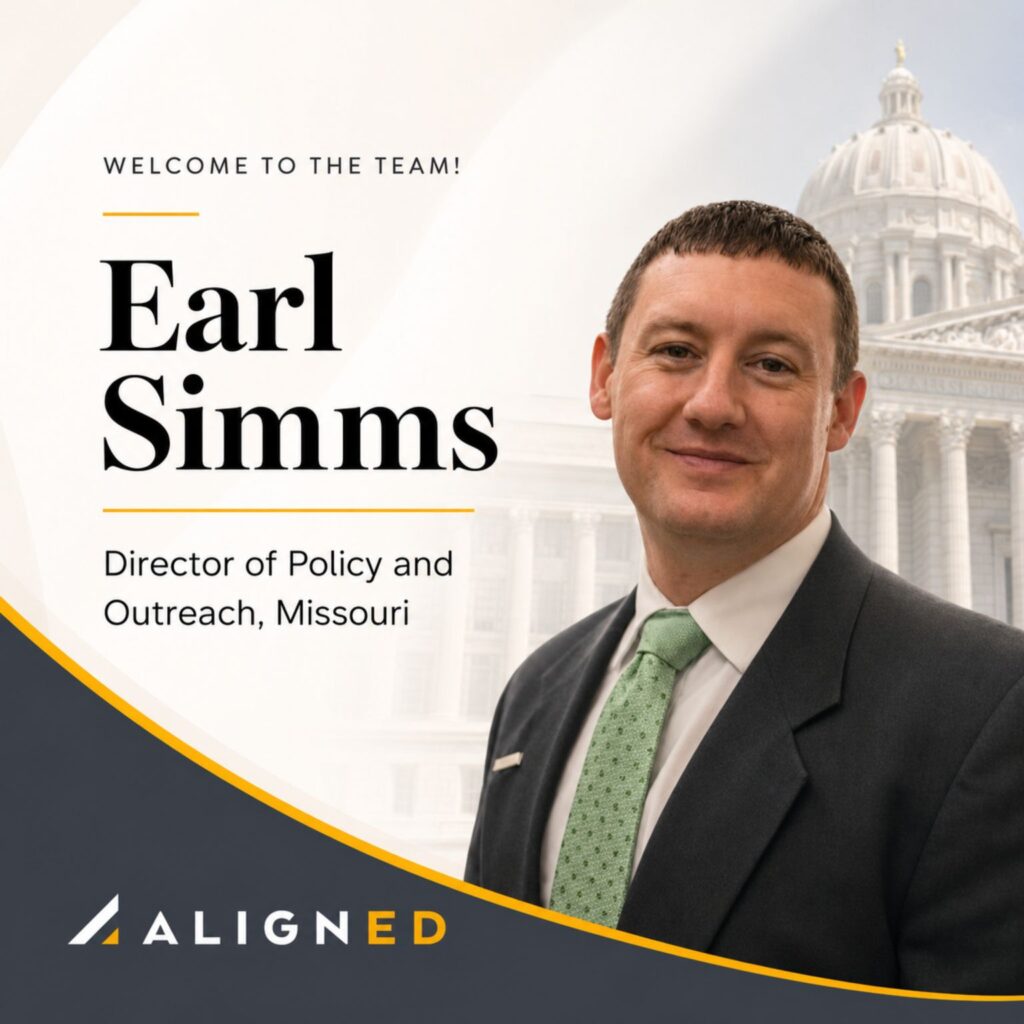
Introducing Earl Simms!
We’re excited to welcome Earl Simms to Aligned as our new Director of Policy & Outreach for Missouri.
Earl brings more than 15 years of experience in Missouri public policy, government relations, and coalition building. Most recently, he served as Public Policy and Advocacy Manager at Paraquad, where he led legislative advocacy and community engagement efforts on behalf of Missourians with disabilities.
He also brings deep experience in Missouri education policy, including previous leadership roles with the Missouri Charter Public School Association and the University of Missouri’s Office of Charter School Operations.
At Aligned, Earl will lead our Missouri legislative advocacy and stakeholder engagement efforts.
We’re thrilled to have him on the team and look forward to the experience and perspective he’ll bring to our work in Missouri.