

On Monday, the Missouri School Funding Modernization Task Force convened in Jefferson City for its ninth full meeting.
The meeting marked a shift in both tone and substance from the Task Force’s earlier work. Instead of analyzing problems with the current formula, the group spent more time teasing out and debating the consequences of a new formula.
Until now, members had largely considered individual policy choices in isolation. However modest some choices may appear individually, their cumulative effect could significantly alter how state funding is distributed among districts.
The Task Force has now narrowed its focus to two potential formula models, examining various design choices associated with each. The discussion naturally shifted to the distributional effects of the models, the overall cost of each, and the political viability of the Task Force’s recommendations due December 1.
The two formula models
The Task Force has not selected a single preferred formula. Instead, it is considering two potential models that differ primarily in how they calculate state and local funding responsibility.
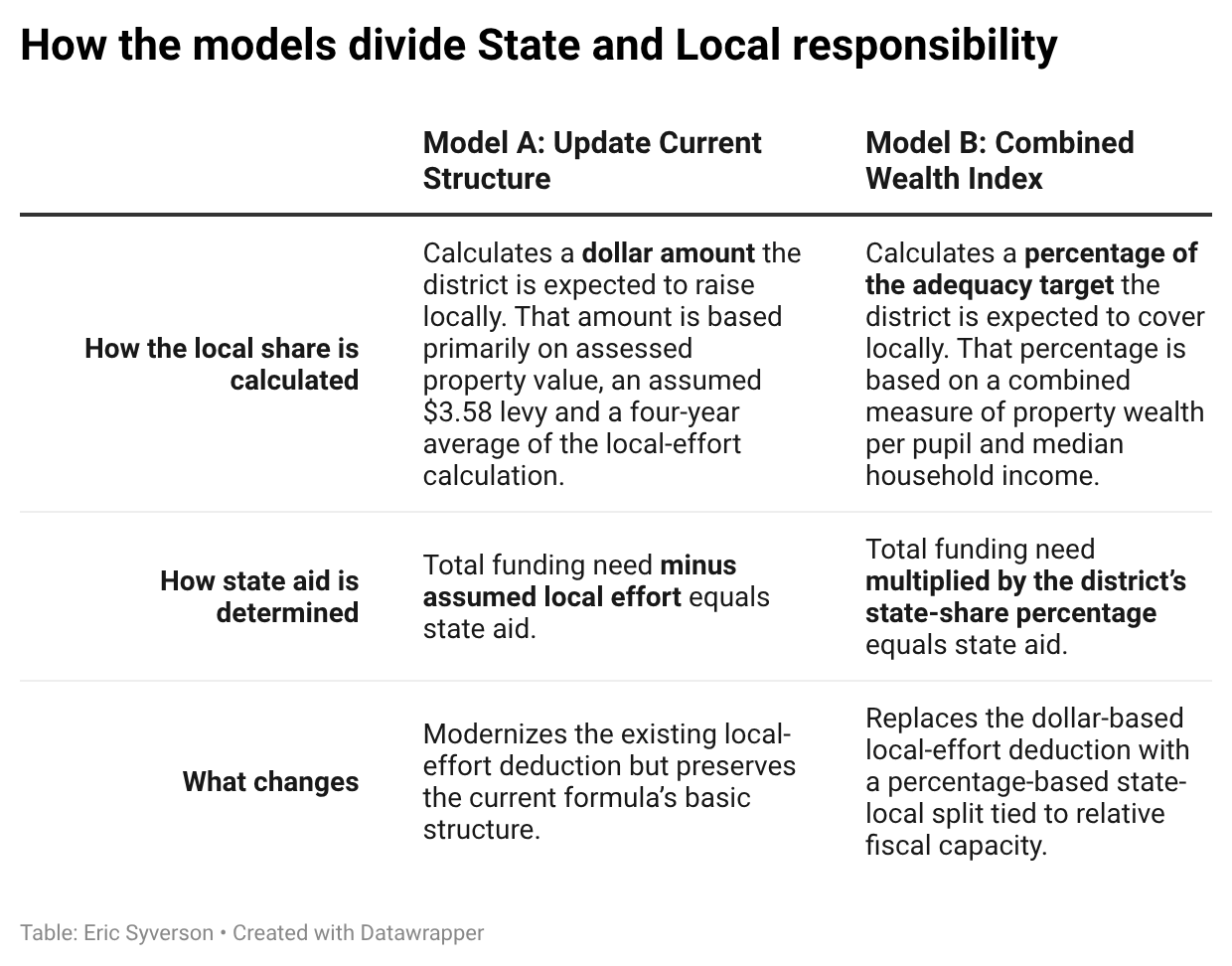
- “Model A” would modernize aspects of Missouri’s current formula but keep its basic structure. The model would update the adequacy target (the base amount of funding per student), introduce a new regional cost adjustment, revise the local effort calculation and add new student weights.
- “Model B” would make more fundamental changes to how state versus local funding responsibility is calculated. It would use a combined measure of district property wealth and area household income to determine what portion of the adequacy target the state would fund. Model B also would incorporate new student weights.
In simple terms, Model A calculates how many dollars a district is expected to raise locally, while Model B calculates the percentage of the adequacy target the district is expected to cover.
After describing the models, Dr. Kari Monsees, the Task Force’s facilitator and former DESE Deputy Commissioner, suggested that the Task Force may ultimately recommend both models, giving the governor and legislators multiple policy options.
Task Force Chair Senator Rusty Black agreed that the Task Force should present a range of options instead of issuing a single recommendation.
While the group is narrowing its focus, the range of possible recommendations remains wide.
The property tax question
In multiple meetings this Spring and Summer, the Task Force has grappled with measuring districts’ local funding capability due to issues with property tax assessment across the state.
To summarize:
- State funding formulas generally estimate how much revenue districts can reasonably generate locally.
- In Missouri, that calculation applies an assumed tax levy to a district’s assessed property value.
- Since counties assess property at different percentages of market value, assessed values do not always provide a consistent measure of local fiscal capacity.
- A district located in an underassessing county can appear less wealthy than it actually is, potentially increasing the state aid calculated on its behalf.
During the July meetingm Task Force member Dr. Michael Podgursky, a Professor at the University of Missouri specializing in education finance issues, presented data that underscored the property-assessment problem.
He looked at county assessment ratios paired with DESE data on student enrollment by county. Using this data, Dr. Podgursky examined the relationship between lower assessment ratios and various student characteristics by county.
He found the following:
- There is little relationship between assessment ratios and student poverty.
- Racial differences were larger, with the mean assessment ratio higher for counties with higher proportions of non-white students versus those with higher proportions of white students (83.6% vs. 79.7%, respectively).
- The difference by race grew when comparing counties with higher portions of Black students (85.1% average assessment ratio) to counties with higher proportions of White students.
- Importantly, these racial differences were driven by the largest counties (Jackson, St. Louis, St. Charles). When they were removed from the analysis, there was no meaningful relationship between lower assessment ratios and race among the remaining counties.
The current formula has been partly insulated from today’s assessment disparities because its local-effort calculation remains tied to property values from the mid-2000s. Dr. Monsees noted that assessment ratios have generally deteriorated as property values rose sharply following the COVID-19 pandemic.
If a new formula relies on current assessed values without accounting for differences in assessment practices, it risks carrying existing distortions into the new system.
In response, the Task Force weighed options to correct the improper assessment practice.
One proposal would gradually adjust assumed assessed values by closing 20% of the gap between a county’s assessment ratio and full market value during each two-year reassessment cycle. The adjustment would be fully phased in over 10 years, using updated assessment ratios along the way.
The Task Force saw the following example for a county with an initial 70% residential assessment ratio, updated to 75% after reassessment.
Year 1: (100% – 70% assessment ratio) x 20% = 6% adjustment to assumed assessed value.
Year 3: (100% – 75%) × 40% = 10% adjustment to assumed assessed value.
The discussion ultimately centered on a broader question: Should the school funding formula correct distortions created by the property tax system, even though school districts do not control that system?
On one side, some members argued that the formula must address this problem.
- They argued that a rational formula should not knowingly rely on inaccurate property values.
- They say that ignoring the problem may undermine financial equity among districts and legal defensibility during possible litigation.
- They pointed to the adjustment formula as one way to create pressure for counties to improve assessment practice.
- Finally, they feared that failure to correct the issue would reward counties that underassess property, creating a perverse financial incentive.
On the other hand, some members thought that the Task Force was drifting out of its lane.
- Some members said that since school districts do not control assessors or influence the State Tax Commission, they should not be financially punished.
- They argued that assessment reform should be handled by other authorities and not a Task Force making recommendations for a new school funding formula.
- Ultimately, they assumed districts would focus on financial losses, making the proposal politically vulnerable.
While the Task Force did not come to a final agreement, an assessed value adjustment remains a policy lever under consideration. The group may also consider a recommendation for property tax policy changes separate from a new formula.
Inevitable consequences of modernization
As the meeting unfolded, members raised several disagreements and concerns. Most stemmed from the reality of adopting a new formula: it will change the distribution of state aid, producing financial winners and losers.
Missouri’s reliance on data and policy decisions made roughly 20 years ago makes that redistribution especially pronounced.
For example, using current property values instead of values frozen in the mid-2000s could increase the amount of local effort attributed to some property-wealthy districts, reducing their calculated state aid.
The best illustration of this tension between designing a rational formula and passing one through the General Assembly came up during the conversation about hold harmless funding.
Missouri’s current formula includes two hold harmless provisions tied to funding levels established under the previous formula.
- Large school hold harmless applies to districts with an average daily attendance above 350 students. It guarantees at least the same amount of state formula funding per weighted pupil that the district received in fiscal year 2004-05, adjusted by a regional cost difference modifier.
- Small school hold harmless applies to districts with an average daily attendance of 350 or fewer. It guarantees at least the same total amount of state formula funding the district received in either FY2004-05 or 2005-06, whichever was higher, adjusted by a regional cost difference modifier.
Essentially, larger districts are protected on a per-pupil basis, while smaller districts are protected on a total-dollar basis. Officials estimated that the large school provision currently costs approximately $60 million, while the small school provision costs approximately $40 million.
Since a new formula would use updated data, any modernization could substantially increase the number of districts losing funding — potentially increasing both the number of districts requiring transition protection and the total cost of hold harmless.
Dr. Monsees and other Task Force members argued that some form of transition protection will likely be necessary to ensure passage through the General Assembly. However, members disagreed when considering the practical application of hold harmless proposals.
Some members argued that the current hold harmless policies were crucial to the old formula’s passage. Then, as now, many small and rural districts faced the prospect of losing funding, generating opposition to the legislation. That rationale led some members to argue a permanent hold harmless will most likely be necessary for a new formula.
Others differed and argued for a temporary hold harmless that phases out over time. These members suggested that a gradual phaseout of protection would provide predictability for districts to adjust their behavior over time.
Several members raised a salient point: the Task Force’s primary responsibility is to design a rational, equitable and sustainable formula. They argued that the potential size and cost of hold harmless should not dictate the structure of the underlying formula.
Designing a formula and managing the transition to it may be two separate issues. But a big question remains: how long should the state protect districts from the consequences of a new formula that the Task Force designed to be more accurate and equitable?
Emerging consensus on some issues
While the meeting surfaced many areas that require more thought and debate, members showed broad support for several components that could be incorporated into either model.
- Using a MERIC-based regional cost factor. Members generally supported replacing the current wage adjustment (Dollar Value Modifier, or DVM) with a factor based on MERIC data. The current DVM relies on federal wage data that are no longer produced in the same form.
- Including additional funding for homeless and gifted students. Members generally favored supporting homeless students and gifted and talented students with additional funding in concept. They previewed different fiscal impacts looking at a range of possible funding weights, although the size of each weight remains unresolved and the Task Force will address in future meetings.
What’s next?
The Task Force will meet again on August 10. The lengthy discussion meant they did not get through their entire agenda.
One major item they did not address but promised to return to: how the formula should account for small and geographically sparse districts, a major sticking point.
Throughout the discussion, task force members repeatedly pointed to the need for district-level simulations to understand how different policy choices would affect individual districts. Aligned has been involved in supporting that modeling work, and we may have more to share in the months ahead.
At the end, the July meeting clarified many of the decisions facing the Task Force as members work to ensure that formula modernization is meaningful, affordable, equitable and politically viable.
Interested in more analysis like this? Sign up for our monthly newsletter!