

This originally appeared in Aligned’s weekly newsletter. Want future updates in your inbox? Sign up today. Also note that this will be our last weekly update; in June we will switch to monthly updates.
New report shows academic recovery is still urgent
A new national report from the Education Scorecard offers us the clearest look at where student achievement stands after the COVID-19 pandemic. The findings are sobering and useful for all of us to keep in mind going forward.
The report, which is authored by researchers from Harvard, Standford, and Dartmouth, points out that the nation’s academic challenges did not begin with the pandemic.
Instead, student achievement entered a “learning recession” around 2013, at which point progress in math and reading stalled and subsequently declined.
While the pandemic has accelerated those losses, the longer-term trend line matters.
For instance, the report shows that the average annual decline in student English language art (ELA)proficiency just before the pandemic was equivalent to the declines during the height of the pandemic.
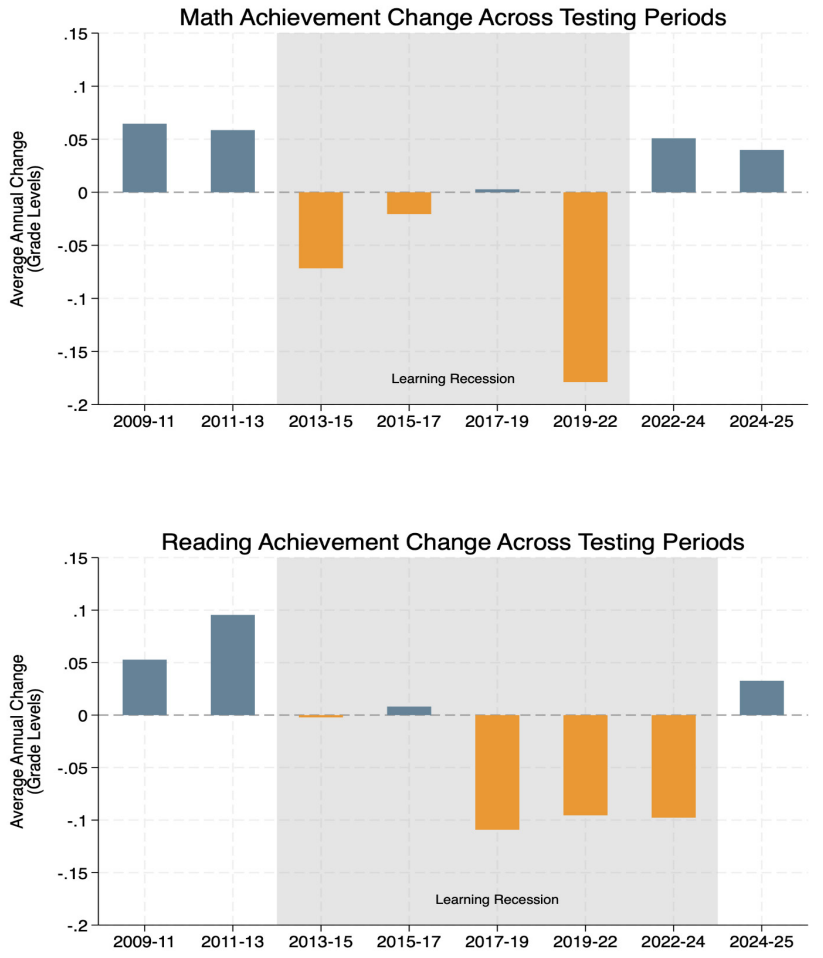
Many have continued to treat these academic challenges as merely a recovery problem. But that misses much bigger questions facing us: why did student achievement slip even before the pandemic, and what will reverse these long-run trends?
The report points to several possible explanations:
- Reduction in test-based accountability measures nationwide
- The rise of smartphone and social media use
- Persistent student absenteeism
- Inequitable implementation of recovery strategies
To be clear, the report does not claim there is one simple cause of these trends. But it does make a compelling case that progress is possible for districts and states when the focus turns to instructional practice, attendance, implementation of programs, and, ultimately, accountability for results.
For us at Aligned, the findings in literacy are especially relevant.
Between 2022 and 2025, only a small group of states improved student ELA scores. Those states notably all implemented multiple elements of evidence-based reforms (i.e., the science of reading) that we have advocated for in both states.
However, not every state that passed these reforms saw improvement. The report goes great lengths to remind us that while policy creates a foundation, implementation, educator support, high-quality instructional materials, coaching, and real-time monitoring are the real difference makers for students.
Classroom practice must change in tandem with state laws.
For Missouri, state data shows the state ranked 26th out of 38 states in math growth and 28th out of 35 states in reading growth between 2022 and 2025. Note: Not all states were compared during the same period due to some not having data for certain years between 2019-2025.
- The average Missouri student is now slightly above 2022 levels in math, but still more than half a grade below 2019 levels.
- In ELA, the average student is about .2 grade equivalents below 2022 levels and .66 grade equivalents below 2019 levels.
- Chronic absenteeism — defined as students missing more than 10% of a school year — has improved from a peak around 2022 but remains 9 percentage points above 2019.
For Kansas, the most recent state data is based on 2024 results due to assessment changes. At that point, Kansas ranked 20th among states in math recovery and 36th in reading recovery between 2019 and 2024.
- The average Kansas student remained .43 grade equivalents below 2019 levels in math, despite making up about .19 grade equivalents between 2022 and 2024.
- In ELA, the average Kansas student remained .6 grade equivalents below 2019 levels after losing an additional .14 grade equivalents between 2022 and 2024.
- Chronic absenteeism improved from 26% in 2022 to 21% in 2024, but that’s much higher than the 2019 rate of 14%.
It’s not all bad news: The report spotlights some great districts making unusual progress compared to similar peers, including Sikeston R-6 in Missouri.
The district was recognized for gains in both math and ELA. The report points to the district’s commitment to teacher-led curriculum development, dedicated interventionists, and career-connected programs for at-risk eighth grade students.
Aligned’s take: Education debates have often ignored important data. Some minimize how much performance has dropped, whereas others focus solely on the pandemic’s effects. To improve student outcomes, states and districts need thorough analysis, thoughtful strategies for change in schools, and openness to learning from places that have successfully reversed these patterns.
We encourage you to look through the full report, which offers state- and district-level breakdowns.
Missouri News
Missouri legislative session ends, but our work continues
As the Missouri General Assembly prepares to adjourn later this afternoon, Aligned’s priority bills do not appear likely to reach the governor’s desk this year.
Those priorities included proposals related to school accountability, child care, early literacy and open enrollment.
The outcome is disappointing, especially considering several of these issues showed real momentum in the legislature earlier this session.
Representative Brenda Shields’ child care tax credit package (HB 2409) was passed out of the House (97-44) in early April.
- Although the bill was voted to pass by the Senate Committee on Emerging Issues and Professional Registration on 05/07, it did not receive a full vote on the Senate floor.
Early literacy legislation (HB 2872, Rep. Loy) also passed out of the House 131-10. The Senate Education Committee later added new school finance transparency requirements.
- The amendment would require school districts and charters to publish detailed financial information online, with Missouri Department of Elementary and Secondary Education (DESE) oversight and the potential withholding of state aid for noncompliance.
- The bill has remained on the Senate’s informal calendar since 05/07.
On school accountability, lawmakers considered — but ultimately did not pass — multiple proposals that would have strengthened how Missouri measures and communicates school performance. That conversation remains important in context of Governor Mike Kehoe’s executive order establishing an A-F school grading system in January.
- Since the A-F system was established by executive order rather than statute, it could still be changed or repealed by a future governor.
- For families, educators, and employers, a durable accountability system matters because it delivers consistent and clear information about how schools are serving students — a thing that parents overwhelmingly value.
Look for action on this issue to return in the future.
Open enrollment legislation also had a different trajectory this year compared to other years. The Missouri General Assembly has taken up the issue each of the last six years. Unlike prior years, when open enrollment proposals advanced out of the House, the major proposals this year came from the Senate: SB 971 (Sen. Trent) and SB 1496, (Sen. Gregory). The chamber did not vote on either bill.
Our big takeaway: Missouri’s education debates are not going anywhere. The state still faces important questions about early literacy, child care access, school performance, student mobility, and the connection between education and broader workforce needs. This session elevated many of these issues, with much of the work unfinished.
The work that remains: Aligned will continue to work with lawmakers, educators, and others around the state during the interim to build on this year’s work, strengthen the proposals, and keep the focus on improving outcomes for Missouri students.
Missouri Commissioner of Education announces retirement
On Tuesday, DESE announced that Dr. Karla Eslinger will retire from her role as Missouri Commissioner of Education on June 1.
In the release statement, Dr. Eslinger spoke about her two-year tenure as Commissioner:
“Serving as Missouri’s Commissioner of Education has been one of the greatest honors of my career […] Over the past two years, I am incredibly proud of the progress we’ve made — enhancing how we use data to guide decisions, strengthening communication with partners, and laying the groundwork for a strategic plan — that will continue to benefit students and educators long after my tenure. Missouri’s educators are deeply committed to their students, and it has been a privilege to support their work.”
Read her full written retirement statement here.
DESE promised to share more about transition plans for the position of Commissioner soon.
Prior to her role as Commissioner, Dr. Eslinger was a state legislator, first as a Representative then as a Senator, from 2019-2024. Dr. Eslinger also had 30 years of educational experience as a classroom teacher, principal, and as a superintendent of schools prior to her time in the General Assembly.
Aligned’s take: We congratulate Dr. Eslinger on her retirement and thank her for a career dedicated to Missouri students, educators and schools.
Her departure comes as Missouri advances several major education policy reforms, including school funding modernization, assessment innovation and the state’s strategic plan. The leadership transition at DESE will be important to watch.
Note that both Kansas and Missouri will have new Commissioners of Education; one starting on June 1, the other leaving on the same day.

Kansas News
Kansas State Board continues discussion on student screen time
The Kansas State Board of Education spent part of its May meetings discussing student device use, screen time and digital safety in schools.
The conversation follows the passage of new legislation limiting student use of cell phones during the school day and restricting school staff from using social media to communicate with students for official school purposes.
Board members discussed the needformore guidance, parent engagement and careful implementation, especially around medical needs, IEPs, English learner supports and local board policies.
The board also heard from USD 494 Syracuse about its pilot of Screen Guardians, a digital wellness and online safety program used across grade levels.
District leaders said the work has helped students better understand how technology affects attention, behavior and mental health, while also prompting families to rethink screen habits at home.
What to watch: the Board’s discussion suggests student device use will remain an active topic for them and Kansas districts in the months ahead.
New accountability and technology leader announced
On Wednesday, the Kansas Department of Education announced that Dr. Zach Conrad will serve as commissioner of the Division of Accountability and Technology beginning July 1.
In this role, Dr. Conrad will lead the agency’s work on accountability, assessment, research, systems evaluation, information technology, and data reporting.
Dr. Conrad brings a wide range of Kansas education experience, including classroom teaching, district leadership, state agency work and research. Most recently, he served in a similar role of Kansas City Kansas Public Schools. He previously held data and technology leadership roles in Lawrence Public Schools and at KSDE supporting assessment and research initiatives.
This portfolio is particularly important, as the state works to improve its accountability and accreditation systems, deliver reliable data, and provide more transparency through technology.
New Aligned blog: Why CEP is more than a school meals debate
This week, Aligned published a new blog looking at how the federal Community Eligibility Provision (CEP) interacts with school finance.
Although the CEP is designed to help schools provide meals to all students without added paperwork, Kansas uses a student’s eligibility for free lunch to identify students from low-income backgrounds to provide additional funding.
The blog covers why school district concerns should be understood as governance and finance questions and highlights that Kansas is considering alternative ways to measure student needs.
Check it out the full piece here.