

This originally appeared in Aligned’s weekly newsletter. Want future updates in your inbox? Sign up today.
A promising side effect of cell phone bans
Much of our work focuses on legislation, data, and the big debates shaping education and workforce policy. However, every once and awhile it’s nice to cover an encouraging story worth the spotlight — especially one that reminds us that policy can bring about positive, unintended consequences.
This week, that story comes from Texas, where state lawmakers recently passed a bell-to-bell cell phone ban.
As we’ve talked about in our support of Kansas and Missouri adopting similar laws, cell phone ban policies aim to cut down in-classroom distractions. But as CBS reports, early evidence from Dallas suggests that less screen time between classes may also enable students to read for fun.
Officials from the Dallas Independent School District showed a significant increase in school library book checkouts:
- In 2024-25 from the start of school to March 31, students checked out 872,430 books.
- During the same period in 2025-26, students checked out 1,084,837 books, representing a 24.35% increase.
- One high school reported an increase from 500 to 1,800 books in the 2025-26 school year.
One school librarian talked about what officials are seeing on the ground:
“I started hearing, ‘Oh, I’m so bored. I can’t get on my phone after I do my work or during lunchtime […] Once they lock into these stories, they don’t seem to care about their phones at all.”
Students spend a significant time on their phones: up to 8.5 hours on average, of which 1.5 takes place during school. We heard about anecdotal evidence from Missouri and other states that phone restrictions may lead to more student reading, but these numbers from Dallas give the idea more weight.
This dynamic stands out because it runs against a longstanding national trend.
Federal data and research indicate that students (especially older ones) read for fun less than previous generations.
- A Pew Research Center analysis of federal NAEP data found that the share of 13-year-olds who read for fun “almost every day” fell from 35% in 1984 to 17% in the 2019-20. Over the same time, the share who said they “never or hardly read” for fun rose from 8% to 29%.
- More recent NAEP data shows the decline continuing after the pandemic, with only 14% of 13-year-olds reading for fun every day in 2023.
- NAEP also reports a relationship between reading habits and performance. For instance, in 2023 51% of 13-year-olds scoring at or above the 75th percentile reported reading for fun at least once a week (compared with 28% of students scoring below the 25th percentile).
This trend extends to adults, too. A 2025 study using American Time Use Survey data from more than 236,000 Americans revealed that daily reading for pleasure has declined from its peak in 2003 of 28% of respondents to 16% in 2023.
Although official research does not yet show that cell phone restrictions increase reading for fun (and, as a result, improve test scores), the basic point remains: students who spend more time reading tend to be stronger readers.
If less screen time can create more opportunities for students to pick up books, that is an encouraging second-order effect worth watching.
Another piece of timely news: Pizza Hut’s BOOK IT! program, a familiar reading incentive for many families, is back in the form of the Summer of Stories challenge. During June —August, parents can use the BOOK IT! app to set reading goals, track progress, and reward students who meet their goals with a certificate for a free one-topping pizza. Early literacy and pizza — what could be better?

Missouri News
Missouri education bills enter the final stretch
The education agenda enters the final few weeks in Missouri with plenty of bills still in the balance, with little certainty as to how they will fair.
Several major bills remain alive, including Aligned priorities like literacy, A-F grading, child care tax credits, and open enrollment.
But these bills are mostly waiting on Senate action, meaning their path forward now depends more on negotiations, available floor time, and if individual proposals will be packaged together into a larger education omnibus.
This is a familiar theme as legislators near the end of session. This year, that process is taking shape already. For instance, Senate Education Committee Chair Rich Brattin has added school district financial transparency requirements in several education bills, fostering a broader debate over public school financial reporting and oversight over the MOScholars program.
The budget in the conference committee also adds another layer to negotiations in the closing weeks.
The lack of final action does not mean the issues have lost momentum. It could mean they become more complicated, as proposals which garnered bipartisan support may become harder to pass after they’re amended, combined with other proposals, or drawn into broader negotiations.
We will learn a lot about what Missouri leaders are going to prioritize in education in the next two weeks.
Missouri launches new AI literacy pathway
In a partnership between the Missouri Department of Higher Education and Workforce Development and Coursera, the state is launching a new AI Literacy course collection.
The MDHEWD says this new pathway is aligned with the U.S. Department of Labor’s AI literacy framework. This move makes Missouri the first state to offer a workforce-aligned AI training and certificate through Coursera.
- Training includes 60 hours of flexible online training from providers such as DeepLearning.AI, Google, IBM and Amazon Web Services.
- Courses are organized around three main areas: “AI literacy for all, strategic AI use, and AI augmented human skills.”
Missouri residents can apply for free access here; participants will receive certificates upon course completion. Those who complete the full pathway will earn an MDHEWD AI Literacy Certificate.

Kansas News
Governor signs expanded employer child care tax credit
On Monday, Governor Laura Kelly signed an Aligned priority bill into law: SB 82.
Kansas has expanded the employer tax credit for businesses that invest in child care services on behalf of their employees or contribute to organizations that expand child care options.
The law clarified the previously underutilized tax incentive for businesses to invest in child care services for their employees. The law also made the tax credit more generous.
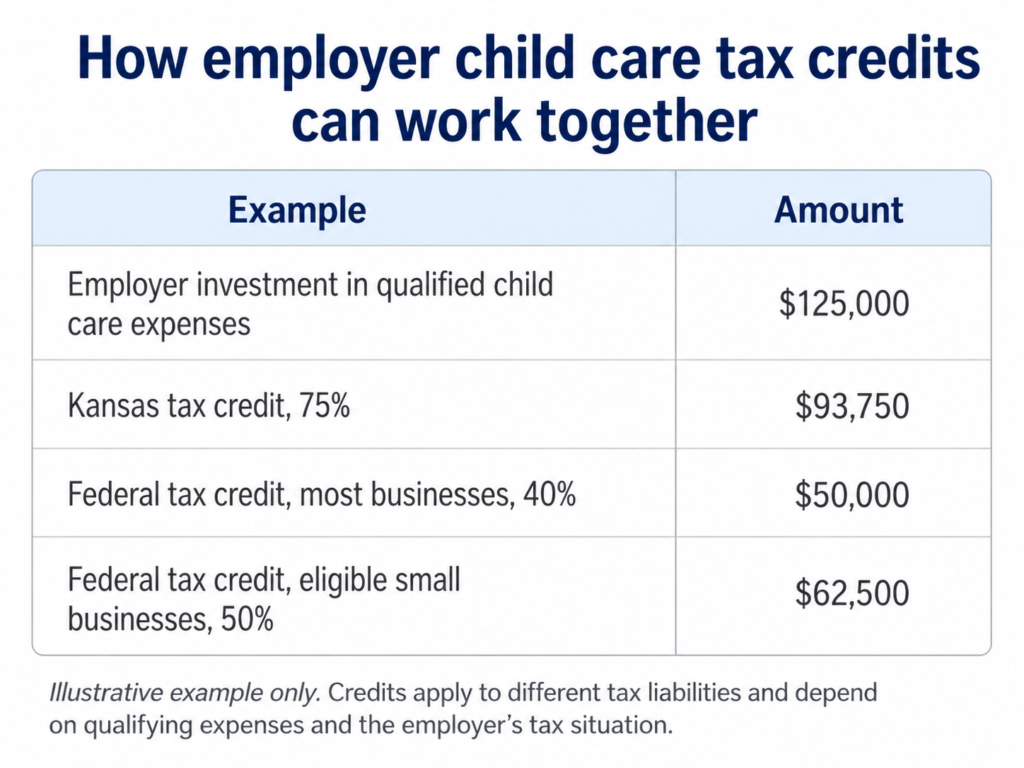
- Starting in the 2027 tax year, businesses can receive credit for 75% of their child care-related expenses up to $100,000.
- Previous law allowed credits of 30% or 50% depending on the expenses and limited credit amounts per taxpayer to $30,000 worth of expenses annually.
The credit is not refundable; instead, it reduces state tax liability, and unused credit may be carried forward for up to three years.
Businesses may also now receive tax credits for contributions to organizations that establish or expand child care services, among other related goals. Tax credits would be 75% of those contributions (or 50% if the organization does not serve families receiving child care subsidies) with a cap of $100,000.
The actual benefit depends on the amount invested and the business’s state tax liability. Both tax credits combined may amount to up to $3 million annually.
The Kansas expansion also comes as the federal employer-provided child care credit is becoming more generous.
- Starting in 2026, federal law increases the credit from 25% of qualified child care expenses to 40% for most businesses and 50% for eligible small businesses.
- The maximum federal credit also rises from $150,000 to $500,000 for most businesses and $600,000 for eligible small businesses.
For employers, the practical takeaway is that child care investments may now carry both state and federal tax benefits. The Kansas credit can help reduce state tax liability, while the federal credit separately applies to their federal tax liability. Those changes hopefully make employer-supported child care a more attractive workforce strategy than it was before.
In her signing statement, Governor Kelly praised the law:
“Throughout my administration, I have strived to make Kansas a place where people want to put down roots […] This is smart, commonsense legislation that will make our state stronger.”
Senate Majority Leader Chase Blasi also complimented the legislation:
“Access to quality, affordable childcare is a hurdle for both employers and employees. I’m proud of the Legislature’s work to simplify and modernize the child care assistance tax credit.”
According to Child Care Aware of Kansas, the state is still short 77,860 child care slots to meet current demand. The good news: the number of families using home-based child care has increased in recent years, and the reported number of child care centers has stabilized after years of declines.
Governor vetoes recess bill, calls for State Board to act instead
On Tuesday, Governor Kelly vetoed HB 2763, a bill that would require school districts to have at least 30 minutes of recess for students K-5 and implement a statewide physical fitness exam.
In her veto message, the governor did not argue against the policy on the merits.
Instead, she suggested that these ideas were already a priority of the State Board of Education and a law requiring them was not necessary:
“The leadership of State Board of Education and the Kansas State Department of Education have agreed to begin taking the steps to implement the Fitness Test once federal guidance is provided to states. They will further reaffirm their recommendation that elementary schools provide a minimum of 30 minutes of recess every school day and work with any school districts not currently following their recommendation to facilitate implementation wherever feasible.”
It’s worth noting that a statutory requirement applicable to all schools versus a State Board recommendation is quite different.
For example, look at the state’s experience with regulating cell phones in schools.
- In 2024, the State Board issued a recommendation for districts to adopt a bell-to-bell cell phone ban.
- A 2025 KSDE survey showed that although many elementary and middle schools had bell-to-bell bans (65% and 60%, respectively), only 31% of high schools could say the same.
- In 2026, the Legislature and Governor Kelly called for and ultimately passed a change to statutory law instituting a bell-to-bell cell phone ban for all schools.
One can easily see the same dynamic playing out in this case. The State Board can recommend daily recess, but school districts still retain final say.
Senator Doug Shane, who supported the legislation, made the point in the Sunflower State Journal:
“I’m disappointed we didn’t think it was important to statutorily protect recess and ensure that kids receive the recess time that they deserve.”
The veto stands in contrast to other states, including those led by Democratic governors, that have enacted stronger recess protections.
- California, Washington and Illinois have all enacted laws guaranteeing at least 30 minutes of daily recess or unstructured playtime for elementary students.
- Pennsylvania Gov. Josh Shapiro has called for a similar statewide guarantee.
Supporters also argued HB 2763 could help the state meet commitments in its rural health application, which anticipates a statewide fitness test mandate by 2028 and improved student performance on the Presidential Fitness Test by 2031.
Kansas has already received ~ $222 million through the federal rural health program and could receive an estimated $1.5 billion over the life of the initiative.
Note: since the legislature adjourned for the year, any vetoes made post-session cannot be overridden.
Aligned’s take: We look forward to the State Board making sure all students have access to at least 30 minutes of recess time and instituting a physical fitness exam. But to be clear, recommendations and requirements are not the same. If the goal is access to recess and better health outcomes for every student, then the state will need to monitor whether guidance alone is sufficient.
The business case for apprenticeships
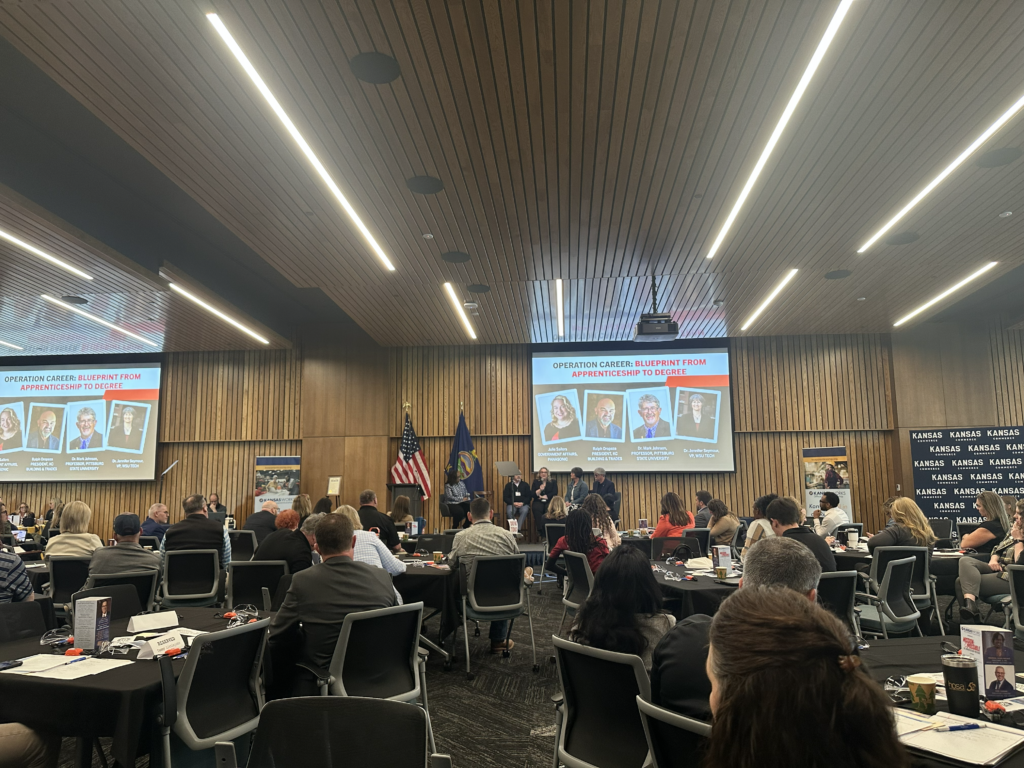
This week, Aligned attended the 4th Annual National Apprenticeship Week Summit in Topeka, hosted by the Kansas Office of Registered Apprenticeship.
The event brought together leaders from education, workforce, business, labor, healthcare, construction, and state government to focus on one clear message: apprenticeships are not just a workforce program; they are a business strategy.
For Kansas employers, the case is becoming harder to ignore. Businesses across the state are facing real talent challenges, from hiring shortages to retention concerns to the need for workers who are prepared with both technical skills and workplace experience. Registered apprenticeships give employers a way to build their own talent pipeline, train workers based on industry needs, and connect students and adults to meaningful careers earlier.
That is especially important for the work we care about at Aligned.
If we want every student prepared, we must think beyond graduation requirements alone. Students need clear pathways that connect education to opportunity.
Apprenticeships help make that connection real by allowing students and workers to earn while they learn, gain hands-on experience, and move into careers that support Kansas businesses and families.
The data also shows that this work is growing in Kansas.
- According to the Kansas Office of Registered Apprenticeship’s 2025 Annual Report, Kansas now has 4,010 active apprentices, 2,423 new apprentices, 211 active programs, and 1,056 active employers.
- The state also saw a 42% year-over-year increase in active apprentices and a 250% increase in active employers.
Apprenticeship is one of the clearest examples of what alignment can look like when K-12, higher education, employers, and workforce partners are moving in the same direction. As Kansas continues to strengthen its workforce pipeline, apprenticeship should remain a key part of the strategy.