

This originally appeared in Aligned’s weekly newsletter. Want future updates in your inbox? Sign up today.
Phone-free schools are not a shortcut to better learning
Last week, we noted one emerging second-order effect on school cell phone bans: when phones are put away, some students may be more likely to pick up a book. That is a hopeful sign, and it speaks to one of the core justifications for phone-free school policies.
If students are less attached to their devices during the day, they may be more present, social, and engaged in the kinds of habits schools are hoping to build.
This week, a new national study on cell phone bans has garnered a significant amount of attention by adding more evidence to the wider debate. Its findings present us with a more complicated, nuanced picture of what these efforts mean for students and schools.
The National Bureau of Economic Research working paper examined the effects of strict school phone restrictions using national data on schools that adopted Yondr lockable phone pouches.
- Students placed their phones in magnetically sealed pouches before school and did not access them until dismissal.
- The study combined Yondr adoption records with GPS-based phone activity, standardized test scores, attendance and discipline data, as well as student and teacher surveys.
- Since ban dates varied, researchers used a staggered design to compare schools adopting pouches against those that had not yet implemented a ban or never did.
- The study used national data from 40,524 schools from 2019 to 2026, including Yondr adoption records that covered 4,607 schools that purchased the pouches.
The clearest finding was that the policy worked in accomplishing its most immediate goal: declines in student phone use during school. GPS-tracked phone activity on school grounds declined after pouch adoption. Further teacher surveys showed a share of students using phones in class for nonacademic reasons fell significantly, too.
However, the study also indicated mixed outcomes for broader education effects.
- The research found that average effects on tests scores were minimal: high schools saw modest positive effects (especially in math) while middle schools showed small negative effects.
- There was little evidence for improvements in attendance, “self-reported classroom attention,” or “perceived online bulling.”
The paper also found short-term implementation challenges. In the first year after adoption, disciplinary incidents increase alongside declines in student-reported wellbeing.
In keeping with prior research from Florida on the subject, these discipline issues fade over time, and student wellbeing rebounds, suggesting that both schools and students need time to adjust to phone-free settings.
Placed in context of other research, this study should not be read as evidence that banning cell phones from schools is a pointless exercise. The study shows that these policies can reduce student phone use during the school day — for many teachers and parents, that alone may be a meaningful improvement to the learning environment.
Certainly, Cape Girardeau’s deputy superintendent Dr. Brice Beck finds value in these polices, who told the New York Times in their coverage of the paper that restricting cell phones has helped teacher recruitment and retention efforts. He also spoke about palpable changes to the school environment:
“At lunch you will see all these kids, they’re talking to one another,” Dr. Beck said. “It’s a lot louder, but the good kind of loud.”
The ultimate takeaway is that there are limits to treating any single policy as a panacea.
Cell phones are distracting. They interrupt instruction, weaken focus, and change social dynamics of any interaction. Reducing that distraction is a defensible goal.
But phones are not the only reason students struggle with reading, adding or subtracting numbers — and phones certainly have little to do with whether students are showing up to school consistently and on time.
Removing phones does not automatically improve how we teach our students, the curriculum students learn from, the support we provide to those who need it, and the efforts to ensure we all hold ourselves accountable for results.
The promise of phone-free schools is that they create better conditions for learning.
Removing one barrier is not the same as improving student outcomes. This is one piece of a wider effort, not a shortcut around the work every generation undertakes: improving how we teach and learn.
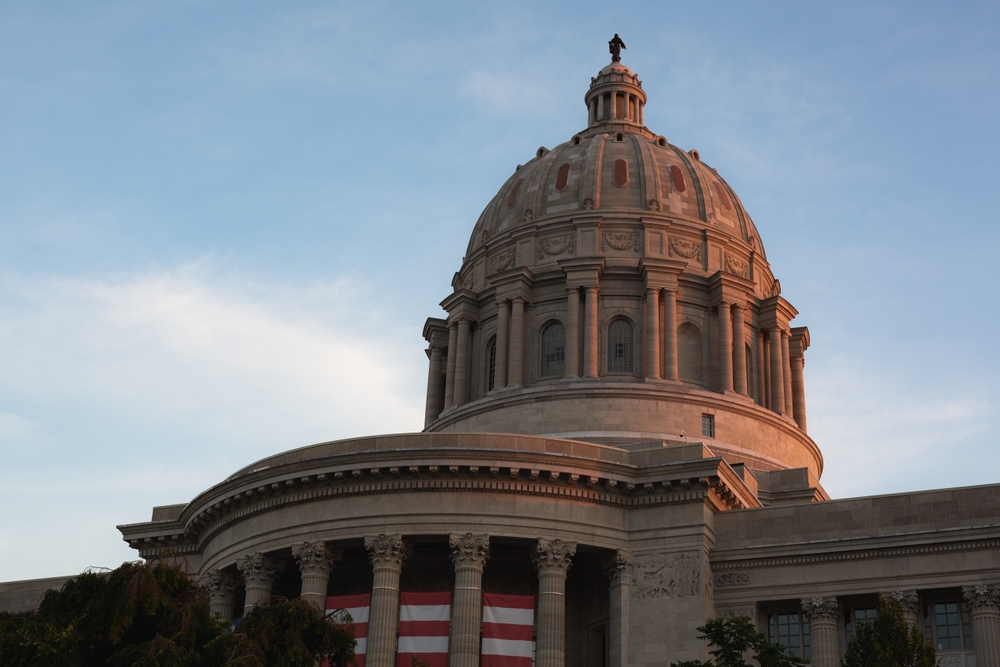
Missouri News
Missouri General Assembly passes a budget ahead of Friday deadline
On Wednesday evening, Missouri lawmakers passed the FY 2027 state budget, with an all-funds total of $50.7 billion. Of that amount, $48.7B is dedicated to state operating expenses, with the remainder set aside for capital construction and maintenance.
The all-funds total includes more than state tax dollars. About $15.9 billion comes from state general revenue, which is funded primarily through state taxes. The rest comes from federal funds and other dedicated state funds and other restricted revenue sources.
The series of budget bills now heads to Governor Mike Kehoe, who may sign or line-item veto individual spending items before the new fiscal year begins July 1.
We will dig into the education toplines, but this budget also highlights the growing fiscal pressure facing the state over the short run.
K-12 and early education toplines
The Department of Elementary and Secondary Education’s budget, HB 2002, totals $8.43B. However, that figure includes more than state aid to public schools, with funding spread across state general revenue, federal funds and other dedicated or restricted state funds.
- State general revenue: $4.77B
- Federal funds: $1.49B
- Other funds: $2.17B
Direct state aid for K-12 public schools flows through three main funds:
- Foundation formula: $4.28B.
- Transportation: $376.6M.
- Small Schools Program: $30M.
The House voted 83–68 in favor of the bill, and the Senate voted to pass 20–13.
The allocation to the foundation formula is slightly below the current year’s level, but the larger concern in the final negotiations was not just the topline amount. Last minute K-12 budget negotiations centered on the use of uncertain revenues to meet school funding commitments.
The final budget assumes the Missouri Lottery will generate about $369M in FY 2027, after lawmakers budgeted for $410M in the current year but actual net proceeds came in closer to $350M. Lottery proceeds account for roughly $106.6M for the foundation formula and another $73.9M for Transportation.
Lawmakers also relied on one-time transfers, including $73.9M from the Capitol Preservation Fund — a dedicated set aside meant to rebuild part of the state capitol building — and $45M from the Blind Pension Fund for the foundation formula. The bill also uses an additional $15.2M from the Capitol Preservation Fund for Transportation.
The questions now are whether those uncertain revenues will meet projections, if the one-time transfers will survive the governor’s veto pen, and where those funds will come from next year.
In addition, conference committee restored $51.5M in funding for child care subsidies.
- That brings the total funding for child care subsidy payments for low-income families to $304.8M.
- Another $57.3M was approved for child care subsidies for children under the care/custody of the Dept. of Social Services Children’s Division.
The final budget bill also changed the reimbursement model the state uses to pay providers to allow a certain number of absences per month, depending on how often they attend child care services.
Last, the bill increased funding for the MOScholars program to $60M, up from $50M in the current year.
This scholarship tax credit program provides funds to students for a wide range of expenses, including private school tuition, tutoring, and other learning materials and services.
Higher education toplines
We have previously discussed a proposal to modify the state’s higher education funding model so that it is determined by student enrollment.
Ultimately, that proposal did not survive final negotiations. However, lawmakers kept the issue alive by ordering the Department of Higher Education and Workforce Development to suggest a formula-driven model for public colleges and universities by December 1.
The FY 2027 DHEWD budget, as outlined by HB 2003, totals $1.397B. The House approved the bill 109–32 and the Senate voted 28–5 in favor. Its topline funding amounts are as follows:
- $1.204B from state general revenues
- $62.3M from federal funds
- $130.8M from other funds
Institutional operational funding amounted to the following:
- University of Missouri: $522.2M
- Community colleges: $184.1M
- Missouri State University: $115.7M
- University of Central Missouri: $68.0M
- Southeast Missouri State University: $56.4M
- Truman State University: $51.1
- State Technical College of Missouri: $9.5M
The proposed model must use these funding totals as its baseline and cannot assume additional appropriations beyond that level.
Overall, the broader fiscal picture is tightening for the state.
In this FY 2027 budget, Missouri uses its surplus to cover a $2.3B gap between general revenue spending and projected general revenue. At the end of April, the balance of the surplus fund was ~$2.9B according to the Missouri Independent, meaning the fund could fall to about $600M by the end of FY 2027 — before the Governor makes cuts through vetoes.
Funding pressure could also mount if revenues continue to come in less than expected: tax collections posted an overall decrease of 10.7% compared to April 2025. Not to mention the forthcoming ballot measure that would gradually eliminate the state income tax, the largest state revenue source.
We will report back once we know more about the Governor’s actions.
Register for Aligned’s Missouri session review webinar
With one week left on the Missouri General Assembly’s calendar, make sure to join Aligned’s post-session webinar to review major education policy developments, key outcomes
We will break down the session’s most important education issues and discuss what they mean for students, schools, families and Missouri’s workforce pipeline.

Kansas News
Wichita weighs another school bond vote
After losing an extremely close school bond ballot measure last February, officials from USD 259 are once again recommending the school board to approve a bond ballot measure.
While many of the bond requests overlap with the previous measure, there are some changes, the most notable of which is the total price tag: $615 million (up from $450M).
The bond measure consists of two questions, with Question 1 being the larger of the two, and it must pass for Question 2 to take effect.
Question 1 includes the core of the district’s requested facility upgrades, including major investments in new construction, school rebuilds, and HVAC upgrades. All told, Question 1 would amount to a bonded price of $407.1M.
Key projects include:
- $192.3M to rebuild Truesdell Middle, Black Elementary, and McLean Elementary schools
- $45.3M to rebuild and convert Chisholm Trail Elementary school into a combined K-8 school
- $45.3M to add a wing and make Cessna Elementary a K-8 school
- $28.2M for the FutureReady Center for Trades
- $40M for preservation work at North and East High schools
- $15M for district-wide HVAC upgrades
Question 2 can only pass if Question 1 passes, and it would fund additional school rebuilding, preservation, and career and technical education improvements (CTE). The total package of Question 2 would cost $207.9M.
Question 2’s key projects include:
- $148M to rebuild and renovate Colemand Middle and rebuild Adams Elementary schools
- $35.9M for CTE improvements at South, Northwest, West, and Heights High schools
- $11M to move Horace Mann to Hadley and Irving to Horace Mann elementary school
- $9M to renovate OK elementary school into an early childhood center
By itself, Question 1 would not increase property taxes. Question 2, which can only pass if voters approve Question 1, would add to the overall bond package and is estimated to increase taxes on a $200,000 home by about $50 per year, implying an increase of 2.17 mills.
What’s next: The school board will vote on whether to refer this bond measure to the voters for the November 3rd election during their upcoming June meeting.
Wichita USD 259 is the largest school district in Kansas, making the outcome of this proposal especially important.
The district also stands out because voters rejected a major bond package last year, bucking the trend of many other communities across Kansas and Missouri approving large facility investments.
This new two-question proposal gives Wichita another chance to address building needs, but it also tests whether district leaders can make a clearer case to voters about scope, cost and priorities.
2026 Kansas legislative session review
Thank you to everyone who joined us Wednesday for Aligned’s 2026 Kansas Legislative Session Review webinar!
We appreciated the chance to walk through the major education policy developments from this year’s session and discuss what comes next as implementation begins.
Aligned also released a companion resource highlighting several key education policy wins from the 2026 session, including: the bell-to-bell cell phone policy, at-risk student accountability, federal funds transparency, foster care school stability, education pathways legislation.
All told, these policies reflect our continued work to strengthen student outcomes, workforce readiness, and Kansas’ education-to-workforce pipeline.
You can find a recording of the webinar and the full resource here.