

This blog provides an overview of Aligned’s Missouri’s Classroom Teacher Experience Series, a three-part analysis examining how shifts in experience, placement, and credentials are reshaping the state’s educator pipeline. Over the next three weeks, we will release the full reports referenced below:
- Part 1: Rising Novices, Growing Veterans, and Shrinking Middle
- Part 2: The Hollow Core: Missouri’s Vanishing Mid-Career Teachers — Mapping the Experience Gap Across Grades and Subjects (2015–2024)
- Part 3: The Fragility of the Missouri Teaching Workforce: How Temporary Fixes are Becoming Permanent Solutions in Missouri Classrooms
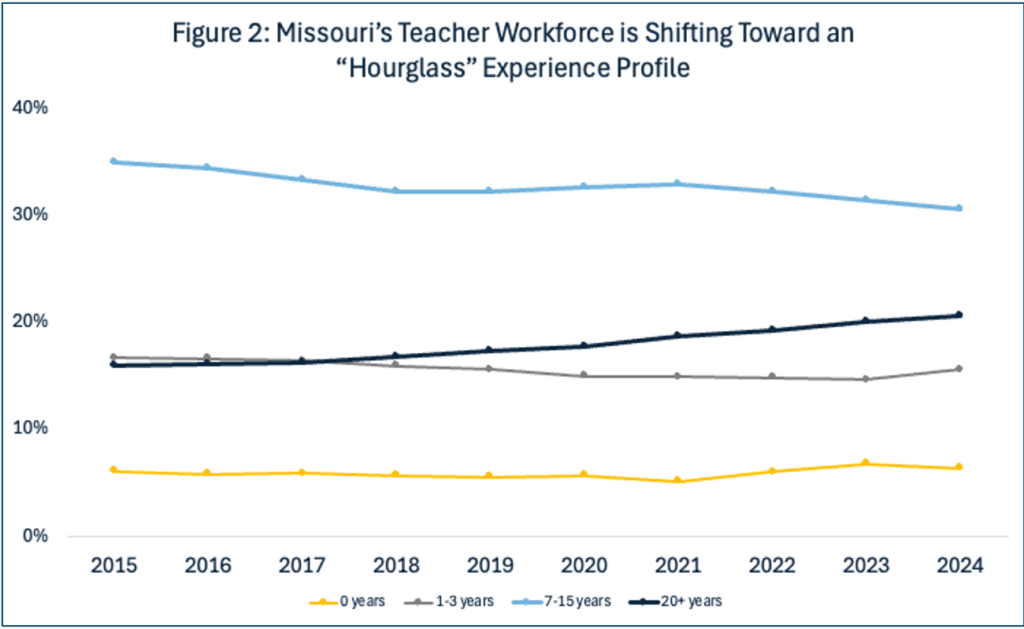
Missouri’s teacher workforce is not as stable as it looks. Over the past decade, the overall number of classroom teachers has remained relatively steady. A closer look reveals a structural shift: the workforce is increasingly shaped like an hourglass.
At the top are veteran teachers nearing retirement. At the bottom, novice educators are growing in number. In the middle, the years when teachers are often at their most effective, a widening gap emerges.
This “missing middle” has important implications for classroom stability, instructional quality, and the long-term sustainability of Missouri’s educator pipeline.
The Growing Hourglass
Between 2015 and 2024, the share of novice teachers in Missouri classrooms, those with one to two years of experience, has increased steadily, particularly since the COVID-19 pandemic. Districts have intensified recruitment efforts to replace teachers leaving the profession.
However, increased hiring has not translated into long-term stability. Missouri is recruiting a similar number of teachers as before the pandemic, but it has a decade-low retention rate of 76 percent, with only before the pandemic, but it has a decade-low retention rate of 76 percent of teachers remaining in their second year of teaching.
In other words, more teachers are entering the profession, but fewer appear to be staying long enough to reach the period when educators typically grow into their most effective instructional roles.
At the same time, the share of teachers with seven to fifteen years of experience, the profession’s instructional backbone, has shrunk dramatically. These mid-career teachers often serve as mentors, instructional leaders, and the steady hands that help schools implement new policies and curriculum initiatives. Their disappearance weakens the institutional knowledge and support structures that help both students and new teachers succeed.
Meanwhile, the upper end of the workforce is expanding. Teachers with twenty-one or more years of experience are now the fastest growing group in Missouri’s classrooms. While veteran educators bring tremendous expertise and commitment, this concentration signals a looming retirement cliff. When many of these teachers reach “25-and-out” retirement threshold, the state’s teacher pipeline may struggle to absorb the loss.
The Disappearing Instructional Core
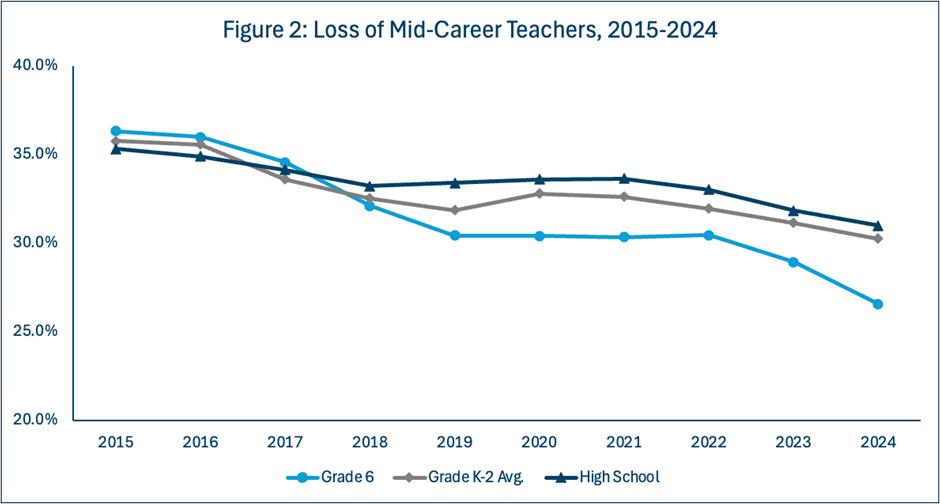
The decline in mid-career teachers is occurring across grade levels and subject areas, but it is particularly severe in the places where instructional stability matters most. We have highlighted particular areas of concern below.
Transition Grades (3–6)
Missouri is seeing the most dramatic losses in the grades where students transition from foundational learning to more complex applications.
- Grade 6 experienced the steepest decline, with a 9.7-percentage-point drop in mid-career teachers between 2015 and 2024.
- Grade 4 saw an 8.6-point decline, Grade 5 a 7.5-point decline, and Grade 3 a 6.7-point decline.
These grades are critical for helping students move from “learning to read” to “reading to learn.” Instability among experienced teachers during these years can disrupt instructional continuity just as academic expectations increase.
Subject-Area Hollowing Out
Missouri’s workforce challenges vary by subject, revealing two distinct patterns.
Some subjects are being hollowed out. Social Studies and English Language Arts (ELA) are losing mid-career teachers the fastest, with declines of 7.5 percentage points and 6.2 percentage points, respectively. These subjects rely heavily on teachers with deep content expertise — skills often refined during mid-career years. Literacy (ELA) outcomes for Missouri students have dropped significantly in the last 10 years. This shift may be one factor contributing to broader declines in student literacy outcomes.
Other subjects face a different problem: aging out. Math and Science show smaller mid-career declines but have rapidly growing shares of teachers with more than twenty years of experience. Today, 21 percent of math teachers and 20 percent of science teachers fall into this late-career category, signaling an approaching wave of retirements.
Underlying Instability in Early Grades
At first glance, the early elementary grades appear relatively stable because recruitment has kept overall staffing levels consistent with new teachers. But beneath the surface, expertise is thinning.
Mid-career teachers are the educators most often responsible for mentoring new hires and helping them navigate the classroom. Yet these mentors are disappearing.
Kindergarten has seen a 5.6-percentage-point decline in mid-career teachers, while Grade 3 has experienced a 6.7-point decline. This matters because Missouri has recently adopted significant literacy reforms, including laws requiring instruction aligned with the Science of Reading. Implementing these initiatives successfully depends heavily on experienced teachers who can guide less experienced colleagues.
Without that support structure, even well-designed policy changes risk uneven implementation.
The Retirement Bubble
To compensate for the shrinking middle workforce, many districts have increasingly relied on veteran teachers staying longer in the profession. This has temporarily masked the loss of mid-career talent but has created a new vulnerability.
Grade 4 provides a clear example. In 2015, about 10.9 percent of teachers had more than twenty years of experience. By 2024, that figure had climbed to 17.9 percent, nearly one in five teachers.
When these educators retire, Missouri may face a surge in vacancies unless the state strengthens both recruitment and retention.
Lowering the Bar: A Notable Shift in Credentials
Missouri’s workforce stability has also been maintained through a shift in teacher credentials.
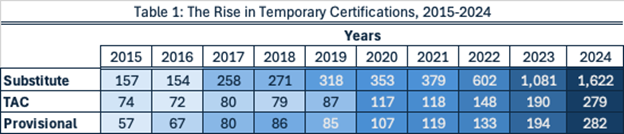
In 2015, nearly 97 percent of classrooms were led by teachers holding full certification, including either a Lifetime or a Professional license. By 2024, that share had dropped to 81.4 percent.
Districts are increasingly relying on alternative pathways and temporary certifications to staff classrooms.
The number of teachers working under substitute certifications has increased tenfold, from 157 classrooms in 2015 to 1,622 in 2024. At the same time, teachers working under Initial Professional Certificates, typically new entrants to the profession, have surged from roughly 1,500 to nearly 7,700, a 387 percent increase.
Together, nearly 2,200 classrooms, roughly one in every school building in the state, are now led by an educator who does not yet hold a full certification. This “emergency” workforce has grown by 450 percent over the last decade.
These shifts illustrate how schools are responding to workforce pressures. While these strategies help keep classrooms open, they also underscore the fragility and quality of the teacher pipeline.
Aligned’s position is clear: Missouri must urgently strengthen both teacher recruitment and retention to stabilize the educator workforce and support student success.
For several years, Aligned has consistently elevated the need for a more intentional, data-driven approach to the teacher pipeline. Now, more than six years post-pandemic, the latest data confirms what many educators and leaders have been experiencing firsthand: Missouri’s system is out of balance, and incremental fixes are no longer enough.
This moment calls for immediate course correction. The state cannot afford to delay meaningful changes to how it recruits, supports, and retains teachers, especially those in the early and mid-career stages. Without a strong pipeline that helps new teachers stay and grow into experienced educators, schools lose the very mentors and instructional leaders needed to drive improvement.
At the center of Aligned’s position is a focus on students. High-quality instruction and consistent mentorship are essential for student learning, particularly as Missouri works to implement key initiatives like literacy reforms and workforce alignment. When the educator system is unstable, students bear the consequences through disrupted learning, uneven implementation of policies, and reduced access to experienced teachers.
In short, Aligned believes Missouri must act now to rebuild a sustainable, high-quality teacher pipeline. Delaying action risks further instability in classrooms and missed opportunities for students across the state.